Professional Food Processing Machinery Manufacturer


Meat Dicing Machine: How to Choose the Right One for Your Production Line — learn how Yuerui Machinery supports your production with reliable equipment and engineering.
In commercial meat processing, few tasks are as deceptively challenging as producing uniform cubes of meat. What appears to be a simple cutting operation is, in reality, a complex process that demands precision engineering, consistent blade sharpness, and careful control of meat temperature and texture. A commercial meat dicing machine solves this challenge by automating the dicing process, transforming irregular cuts of raw meat into perfectly uniform cubes at speeds that would be impossible by hand. Whether you operate a sausage factory, a ready-meal production facility, or a large-scale butcher operation, selecting the right meat dicing machine is a decision that impacts product quality, production efficiency, and ultimately your profitability. This guide provides a comprehensive framework for evaluating, selecting, and maintaining the ideal meat dicing equipment for your production line.
What Is a Meat Dicing Machine?
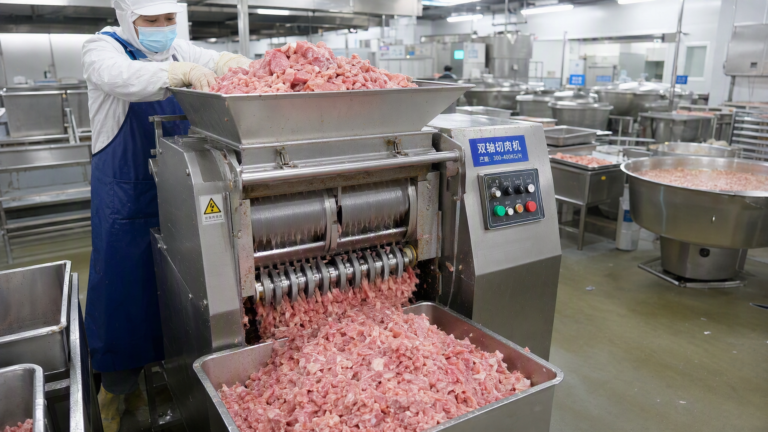
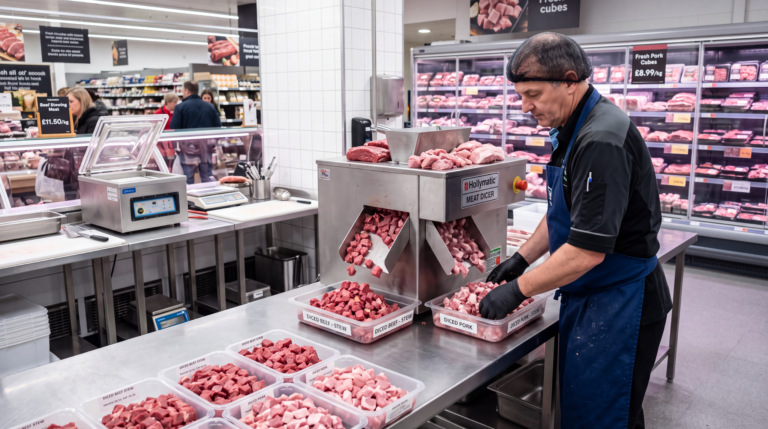
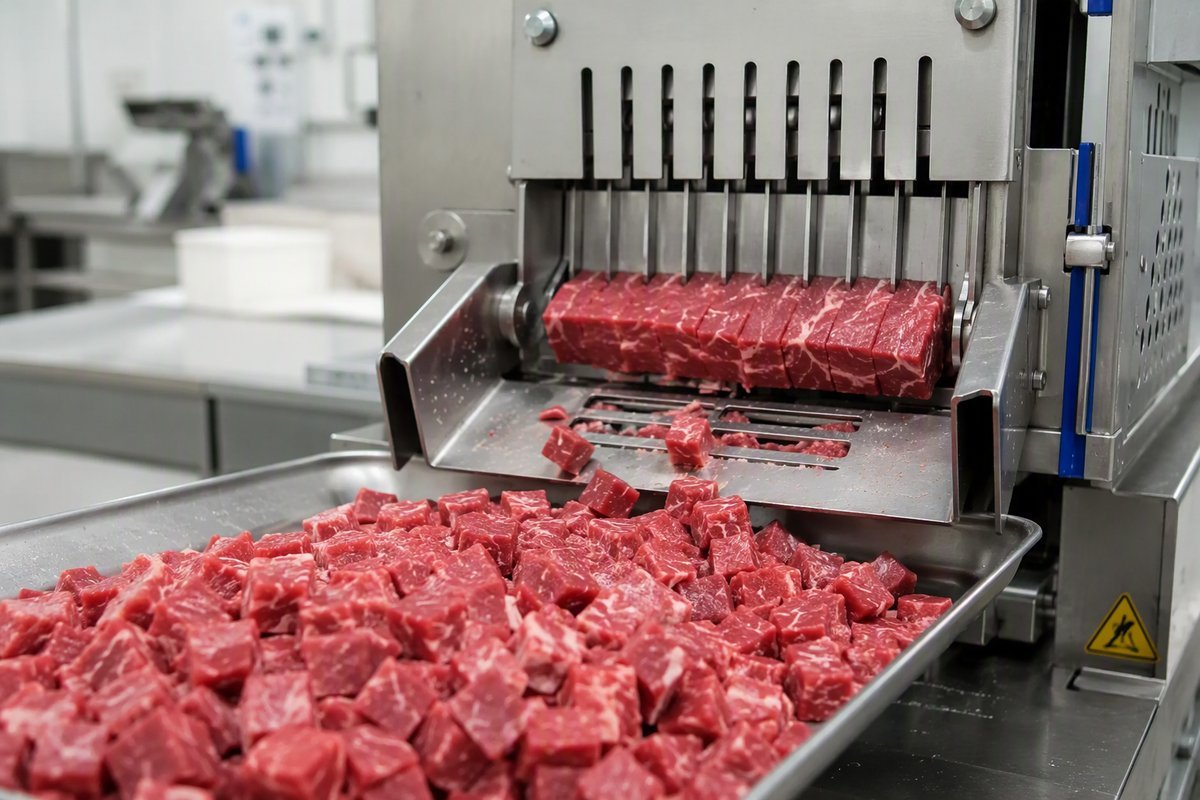
A meat dicing machine is a specialized piece of commercial meat processing equipment designed to cut fresh, chilled, or slightly frozen meat into uniform cubic shapes. Unlike simple slicers that produce flat cuts, a meat dicing machine performs a three-dimensional cutting operation: first slicing the meat into slabs, then cutting those slabs into strips, and finally cutting the strips into cubes. This multi-stage cutting process is achieved through a combination of rotating circular blades, crosscut knives, and a feeding mechanism that advances the meat through each cutting stage in sequence.
The engineering behind a quality meat dicing machine is more sophisticated than it might appear. The cutting system must maintain precise blade alignment under significant mechanical stress, as dense muscle tissue exerts considerable resistance against the blades. The feeding mechanism must advance meat at a consistent rate to ensure uniform cube dimensions, while the blade materials must hold their edge through thousands of cutting cycles without chipping or deforming. Modern machines address these challenges with precision-machined components, high-hardness blade steels, and sophisticated tension and alignment systems.
The output of a meat dicing machine is immediately visible in the quality of the final product. Uniform cubes cook evenly, absorb marinade consistently, and present a professional appearance in packaged products. For food manufacturers producing diced meat for stews, kebabs, pet food, or institutional meals, the consistency delivered by a meat dicing machine is not a luxury—it is a requirement for meeting product specifications and customer expectations.
Types of Meat Dicing Machines
The meat dicing machine market offers several distinct categories, each engineered for specific production scales, meat types, and cube specifications. Understanding these categories is essential for matching equipment to your operational requirements.
1. One-Time Forming Dicing Machines
One-time forming machines represent an innovative approach to meat dicing, where the meat is cut into cubes in a single pass through a complex blade assembly. Rather than the traditional three-stage slicing-stripping-dicing process, these machines use an integrated cutting head that performs all three cuts simultaneously. This design offers significant advantages in terms of speed and cut consistency, as the meat does not need to be repositioned between cutting stages. The Fresh Meat One-Time Dicing Machine exemplifies this approach, delivering high-speed dicing with exceptional cube uniformity for fresh and chilled meat applications.
2. Secondary Forming Cutting Machines
Secondary forming machines take a two-stage approach to meat dicing. In the first stage, the meat is pre-cut into strips or large chunks by a preliminary blade assembly. In the second stage, these strips are fed through a crosscut mechanism that produces the final cube shape. This two-stage approach allows for greater flexibility in cube size and is particularly well-suited for processing irregular meat shapes or partially frozen meat. The Secondary Forming Cutting Machine offers this flexible approach, making it ideal for operations that handle varied product specifications.
3. One-Time Forming Chopping Machines
Designed for heavier-duty applications, one-time forming chopping machines combine the efficiency of single-pass cutting with a more robust chopping action that can handle tougher meat cuts and larger pieces. These machines are ideal for operations that need to process whole muscle cuts, trimmed beef, or pork shoulder into diced product. The One-Time Forming Chopping Machine provides the power and precision needed for demanding commercial dicing applications, offering both high throughput and consistent cube quality.
4. Industrial Inline Dicing Systems
For large-scale food manufacturing operations, industrial inline dicing systems are designed to integrate seamlessly into automated production lines. These systems feature conveyor-fed infeed, automatic product alignment, and high-speed cutting heads that can process several tons of meat per hour. They often include integrated weighing, metal detection, and packaging interfaces, creating a fully automated dicing and packaging workflow. While these systems represent a significant capital investment, their throughput and automation capabilities make them indispensable for large-scale meat processing facilities.
Key Specifications to Consider
Evaluating a meat dicing machine requires attention to a specific set of technical parameters that determine the machine’s suitability for your production requirements. Each specification impacts either the quality of the diced product, the efficiency of the operation, or the long-term reliability of the equipment.
Dicing Capacity and Throughput
Capacity is typically specified in kilograms per hour and represents the maximum sustained throughput the machine can maintain under normal operating conditions. Small commercial machines may process 200-500 kg/h, while mid-range models handle 500-1000 kg/h, and industrial systems can exceed 2000 kg/h. When evaluating capacity, consider that real-world throughput is typically 60-80% of the rated maximum, as it accounts for loading time, blade changes, and cleaning intervals. Always select a machine whose rated capacity exceeds your peak demand by at least 25% to ensure consistent performance during high-volume periods.
Cube Size Range
The range of cube sizes a machine can produce is a critical specification, particularly for operations that handle multiple product lines. Most commercial meat dicing machine models can produce cubes ranging from 5mm to 30mm, with some industrial models extending to 40mm or larger. Cube size is determined by the spacing of the crosscut knives and the feed rate of the meat through the cutting head. Machines that offer quick-change blade sets for different cube sizes provide greater operational flexibility, allowing you to switch between product specifications without significant downtime.
Blade System and Material
The blade system is the heart of any meat dicing machine, and its design directly determines cut quality and blade longevity. Key blade specifications include:
- Blade material: Food-grade stainless steel (440C or equivalent) with high hardness (HRC 55-60) for edge retention and corrosion resistance
- Blade thickness: Typically 2-3mm for commercial machines; thicker blades resist deflection but produce wider kerf (cut waste)
- Edge geometry: Precision-ground cutting edges that maintain sharpness through extended use
- Blade tension system: Mechanical or pneumatic tension that keeps blades properly aligned under cutting load
Meat Temperature Tolerance
The temperature of the meat being processed significantly impacts both cut quality and machine performance. Fresh meat at room temperature (15-20°C) is soft and tends to deform under cutting pressure, producing ragged edges. Chilled meat (0-4°C) firms up and cuts more cleanly but requires more blade power. Partially frozen meat (-2 to -5°C) produces the cleanest cuts but demands significantly more cutting force and can accelerate blade wear. Ensure the meat dicing machine you select has sufficient motor power and blade rigidity for your preferred processing temperature.
Motor Power and Drive System
Motor power for commercial meat dicing machines ranges from 1.5 kW to 7.5 kW or more. The required power depends on the meat type, processing temperature, cube size, and desired throughput. Undersized motors will stall under heavy loads, producing inconsistent cuts and potentially damaging the drive system. Look for machines with overload protection that automatically stops the motor before damage occurs, and consider models with variable frequency drives (VFD) that allow speed adjustment for different meat types and temperatures.
Construction Material and Hygiene Design
All food contact surfaces must be manufactured from food-grade AISI 304 stainless steel. The frame and structural components should also be stainless steel for wash-down compatibility. Critical hygiene design features include:
- Smooth, continuous welds without crevices or pockets
- Sloped surfaces that prevent water pooling
- IP54 or higher enclosure rating for electrical components
- Tool-free disassembly of food contact components for cleaning
- Sanitary design of infeed and discharge chutes
Automation and Control Features
Modern meat dicing machine models offer varying levels of automation that can significantly impact labor requirements and product consistency:
- Manual feed: Operator loads meat by hand; lowest cost but lowest throughput
- Semi-automatic feed: Powered conveyor or pneumatic pusher assists feeding
- Fully automatic: Integrated conveyor system with product alignment and continuous feed
- Programmable controls: Recipe storage for different products, automatic blade speed adjustment, and production data logging
Comparison Table: Meat Dicing Machine Models
The following table compares key specifications across the main categories of meat dicing machine types to help you identify the best match for your operation:
| Specification | One-Time Forming Dicer | Secondary Forming Cutter | One-Time Forming Chopper | Industrial Inline System |
| Motor Power | 2.2-3.0 kW | 1.5-2.2 kW | 3.0-5.5 kW | 5.5-15 kW |
| Capacity | 500-1000 kg/h | 300-600 kg/h | 800-1500 kg/h | 1500-5000+ kg/h |
| Cube Size Range | 5-25mm | 8-30mm | 10-40mm | 5-40mm |
| Meat Temperature | 0-15°C | -2 to 15°C | -5 to 15°C | -5 to 10°C |
| Cut Quality | Excellent | Very Good | Good | Excellent |
| Best For | Standard dicing, fresh meat | Varied products, semi-frozen | Heavy-duty, large cuts | Large-scale manufacturing |
| Automation Level | Semi-automatic | Manual to semi-auto | Semi-automatic | Fully automatic |
| Price Range | $2,000-$5,000 | $1,500-$4,000 | $3,000-$8,000 | $10,000-$50,000+ |
Applications and Use Cases
The meat dicing machine serves a critical role across multiple segments of the food processing industry. Understanding these applications helps illustrate the versatility and necessity of this equipment.
Sausage and Cured Meat Production
In sausage manufacturing, diced meat is a primary ingredient for coarse-ground and chunk-style sausages. Consistent cube size ensures even distribution throughout the sausage matrix, uniform curing, and consistent texture in the finished product. A meat dicing machine dedicated to sausage production can process pork shoulder, beef chuck, and other raw materials into precisely sized cubes that meet exacting product specifications.
Ready Meals and Frozen Food Manufacturing
The ready meal industry is one of the largest consumers of diced meat, using it in products ranging from beef stew to chicken tikka masala. Uniform cubes are essential for even cooking, consistent portioning, and visual appeal in packaged meals. Food manufacturers require meat dicing machine equipment that can handle high volumes while maintaining strict cube size tolerances to meet retail product specifications.
Institutional Food Service
Hospitals, schools, military installations, and correctional facilities prepare large volumes of diced meat for stews, casseroles, and other mass-feeding applications. These operations benefit from the labor savings and consistency of a commercial meat dicing machine, which can process a day’s worth of diced meat in under an hour, freeing kitchen staff for other preparation tasks.
Pet Food Manufacturing
The pet food industry uses enormous volumes of diced meat for both fresh-frozen and canned pet food products. Pet food manufacturers typically require large-capacity machines that can handle variable meat inputs and produce consistent cube sizes for product standardization. The ability to process both fresh and frozen meat is particularly valuable in this application, as pet food manufacturers often work with frozen raw materials.
Kebab and Skewer Production
Commercial producers of kebabs, skewers, and grilled meat products require uniformly diced meat for consistent cooking and presentation. A meat dicing machine can produce the exact cube size needed for specific kebab styles, ensuring that each skewer cooks evenly and meets portion weight specifications.
Bone Broth and Soup Base Production
Manufacturers of commercial soups, broths, and soup bases use diced meat to flavor and texture their products. Uniform dicing ensures even flavor release during cooking and consistent particle size in the finished product, which is particularly important for products where visible meat pieces are a quality indicator.
Maintenance Tips for Meat Dicing Machines
A meat dicing machine operates under significant mechanical stress, cutting through dense muscle tissue thousands of times per hour. Proper maintenance is essential not only for food safety but also for preserving cutting precision and extending equipment life.
Daily Cleaning and Sanitization
Meat residue is highly perishable and can harbor dangerous bacteria if not properly removed. After each production shift, disconnect power and disassemble all food contact components. Wash blades, cutting head assemblies, feed chutes, and discharge tables with hot water (82°C or above) and food-safe detergent. Use a soft nylon brush to remove meat fibers from blade gaps and cutting head slots. Sanitize all surfaces with an approved food-grade sanitizer, rinse thoroughly, and allow to air dry. Never reassemble a wet machine, as trapped moisture promotes bacterial growth between components.
Blade Inspection and Sharpening
Inspect blades before each shift for nicks, chips, and edge dullness. Even minor blade damage produces visible cut quality degradation—ragged edges, torn meat fibers, and inconsistent cube dimensions. Most meat dicing machine blades can be professionally sharpened 3-5 times before requiring replacement. Maintain a rotation of sharp blade sets so that dull blades can be exchanged without production interruption. When installing blades, verify proper alignment and tension according to the manufacturer’s specifications—misaligned blades are a leading cause of uneven cubes and premature blade wear.
Cutting Head Maintenance
The cutting head assembly, which houses the crosscut knives and blade grid, requires regular inspection and adjustment. Check for blade loosening, which can occur due to vibration and temperature changes. Verify that the crosscut knife clearance is set according to the manufacturer’s specification—excessive clearance produces torn cubes, while insufficient clearance causes blade contact and rapid wear. Lubricate cutting head bearings and slide mechanisms with food-grade lubricant according to the maintenance schedule.
Motor and Drive System Care
Monitor the motor for unusual noise, vibration, or heat during operation. Check that motor cooling vents remain clear of meat dust and debris. For belt-driven machines, inspect drive belts monthly for wear and tension, replacing them before they fail. For gear-driven systems, check oil levels and look for signs of leakage. Keep a maintenance log recording motor hours, service dates, and any anomalies to enable predictive maintenance.
Preventive Maintenance Schedule
Establish a formal preventive maintenance program for your meat dicing machine with the following intervals:
- After each shift: Full disassembly, cleaning, and sanitization
- Daily: Blade inspection and cutting head check
- Weekly: Blade sharpening (if needed), drive belt inspection, fastener torque check
- Monthly: Motor inspection, bearing lubrication, electrical connection check
- Quarterly: Full alignment check, blade tension system service, seal replacement
- Annually: Professional overhaul, including motor service, gearbox oil change, and complete cutting head refurbishment
Buying Guide: How to Choose the Right Meat Dicing Machine
Selecting the right meat dicing machine requires a systematic evaluation of your production needs, product specifications, and operational constraints. The following step-by-step process will guide your decision.
Step 1: Define Your Product Specifications
Start by documenting your exact product requirements: cube sizes, meat types (beef, pork, poultry, lamb), meat temperature at processing, and daily volume. If you produce multiple products with different cube sizes, list all specifications and note the frequency of each. This document becomes the baseline against which you evaluate candidate machines.
Step 2: Calculate Required Throughput
Determine your required throughput by calculating the total weight of diced meat needed per production shift, then dividing by available processing hours. Add a 25-30% buffer for setup, cleaning, and blade changes. For example, if you need 1000 kg of diced meat per 8-hour shift, your required sustained throughput is 125 kg/h (1000 ÷ 8). Adding a 30% buffer, you should look for a machine rated at least 160 kg/h.
Step 3: Evaluate Cube Size Flexibility
If you produce multiple cube sizes, evaluate how quickly and easily each candidate meat dicing machine can be converted between sizes. Some machines require complete blade set changes that take 20-30 minutes, while others use quick-change systems that can be swapped in under 5 minutes. Frequent size changes can significantly impact daily throughput if conversion is slow.
Step 4: Match Motor Power to Your Meat Types
Hard, cold meat requires more cutting power than soft, warm meat. If you process partially frozen meat or dense beef cuts, select a machine with at least 3.0 kW motor power. For softer meats like pork and poultry at chilled temperatures, 1.5-2.2 kW may be sufficient. Always verify that the motor has adequate overload protection to prevent damage during heavy cutting loads.
Step 5: Assess Hygiene and Cleaning Requirements
Review the machine’s design from a cleaning perspective. How many components must be removed for thorough cleaning? Are special tools required? How long does a complete clean take? In regulated environments, look for machines with sanitary design certifications and documented cleanability. The time required for daily cleaning is a recurring labor cost that should factor into your total cost of ownership calculation.
Step 6: Consider Automation Level
Evaluate whether manual, semi-automatic, or fully automatic feeding is appropriate for your operation. Manual feeding is suitable for small operations with labor available, but it limits throughput and introduces operator variability. Semi-automatic feeding with a powered conveyor can increase throughput by 30-50% over manual operation. Fully automatic systems are justified for high-volume operations where labor savings offset the higher equipment cost.
Step 7: Evaluate Manufacturer Support and Spare Parts
A meat dicing machine is a long-term investment, and manufacturer support is critical. Evaluate warranty coverage, spare parts availability, and technical support responsiveness. Yuerui Machinery offers comprehensive product documentation, a global spare parts network, and responsive customer service. Ask for references from operations similar to yours, and verify that the manufacturer can provide blades and wear parts for the expected life of the machine.
Step 8: Calculate Total Cost of Ownership
Factor in all costs over a 5-7 year period:
- Purchase price
- Blade replacement costs (sharpening and new sets)
- Electricity consumption
- Cleaning and maintenance labor
- Estimated repair costs
- Downtime cost during maintenance
A more expensive machine that is more reliable, easier to clean, and uses longer-lasting blades may have a lower total cost of ownership than a cheaper alternative.
Common Mistakes to Avoid
- Processing meat at wrong temperature: Meat that is too warm will smear and produce ragged cuts. Meat that is too frozen can damage blades and overload the motor. Follow the manufacturer’s recommended temperature range.
- Neglecting blade maintenance: Dull blades are the primary cause of poor cube quality and increased motor strain. Establish a rigorous blade inspection and sharpening schedule.
- Overloading the feed chute: Forcing too much meat through the machine at once causes stalling, uneven cuts, and potential blade damage. Feed at a consistent, moderate rate.
- Inadequate cleaning between products: Cross-contamination between different meat types or allergen-containing products is a serious food safety risk. Thoroughly clean and sanitize between product changeovers.
- Ignoring alignment adjustments: Blade alignment drifts over time due to vibration and wear. Regular alignment checks prevent quality degradation and extend blade life.
Conclusion
A meat dicing machine is a cornerstone of efficient, consistent meat processing. From small butcher operations to massive food manufacturing facilities, the ability to produce uniform meat cubes quickly and reliably is essential for meeting product specifications, controlling costs, and satisfying customer expectations. The key to a successful investment lies in thoroughly understanding your production requirements and matching them to the right machine type, specifications, and manufacturer support.
By carefully evaluating throughput needs, cube size requirements, motor power, hygiene design, and total cost of ownership, you can select a meat dicing machine that will deliver consistent performance and a strong return on investment over many years of operation. Remember that this is a long-term investment—the cheapest machine is rarely the most cost-effective, and the most expensive is not always the best fit. Focus on alignment with your specific needs, backed by solid manufacturer support. With proper selection, operation, and maintenance, a quality meat dicing machine from a reputable manufacturer like Yuerui Machinery will be a reliable and profitable addition to your production line for years to come.