Professional Food Processing Machinery Manufacturer


Steamed Bun Machine: Complete Guide to Automatic Baozi Production — learn how Yuerui Machinery supports your production with reliable equipment and engineering.
The steamed bun, or baozi, is one of the most beloved and widely consumed foods across Asia and increasingly around the world. As global demand for authentic Chinese cuisine continues to grow, food manufacturers and restaurant chains face a critical challenge: producing consistent, high-quality steamed buns at commercial scale. The answer to this challenge lies in the steamed bun machine, a sophisticated piece of food processing equipment that automates the entire baozi production process from dough portioning through filling insertion to final shaping. Whether you operate a central kitchen for a restaurant chain, a frozen food manufacturing facility, or a large-scale bakery supplying Asian markets, a steamed bun machine can transform your production capabilities, reduce labor dependency, and deliver the product consistency that modern food businesses demand. This comprehensive guide covers everything you need to know about selecting, operating, and maintaining the right steamed bun equipment for your operation.
What Is a Steamed Bun Machine?
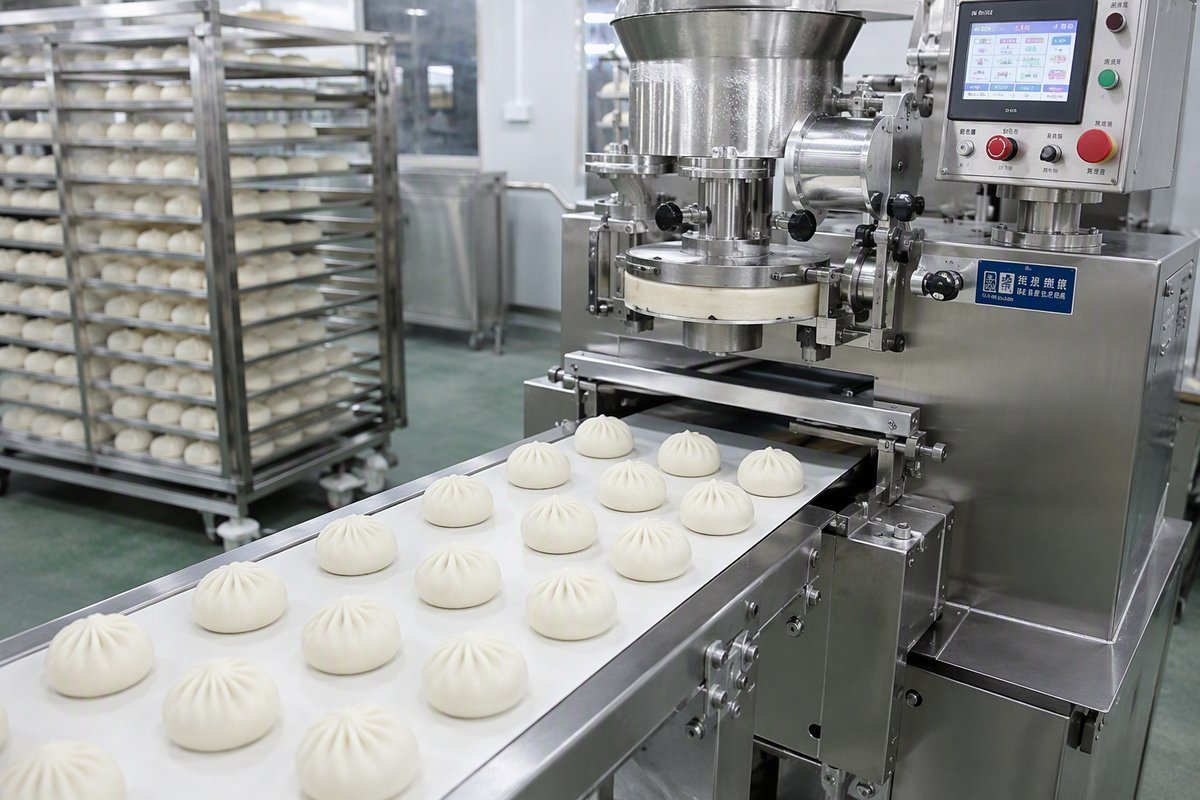
A steamed bun machine is a specialized piece of commercial food processing equipment designed to automate the production of baozi (filled steamed buns) and sometimes mantou (unfilled steamed buns). The machine integrates multiple production steps into a single continuous process: dough feeding and portioning, filling preparation and injection, dough wrapping around the filling, and final shaping into the characteristic bun form. By automating these steps, a steamed bun machine replaces what would otherwise be a labor-intensive manual process requiring skilled workers who can hand-wrap buns at speeds of perhaps 300-500 per hour. A single machine can produce 1,500 to 6,000 or more buns per hour, dramatically increasing throughput while maintaining or improving product consistency.
The engineering behind a modern steamed bun machine is remarkably sophisticated. The dough system must handle soft, yeast-leavened dough gently enough to preserve the gas cell structure that gives steamed buns their characteristic light, fluffy texture. The filling system must be capable of handling a wide variety of filling types—from thick meat pastes to chunky vegetable mixtures to liquid-rich soup fillings—without clogging, dripping, or altering the filling’s texture. The wrapping mechanism must enclose the filling completely while creating the characteristic pleated top that identifies a properly made baozi. Achieving all of this in a single machine requires precision mechanical engineering, food-grade materials throughout, and intelligent control systems that coordinate the timing of each production step.
The impact of a steamed bun machine on a commercial operation is profound. Beyond the obvious labor savings, the machine delivers product consistency that is simply unattainable with manual production. Every bun has the same weight, the same filling-to-dough ratio, the same shape, and the same appearance. This consistency is critical for packaged products, restaurant chain standardization, and export products that must meet strict quality specifications. For businesses looking to scale their steamed bun production, the machine is not just an efficiency tool—it is the enabling technology that makes large-scale commercial production possible.
Types of Steamed Bun Machines
The steamed bun machine market offers several distinct categories, each designed for specific production scales, product types, and operational requirements. Understanding these categories is essential for selecting the right equipment for your business.
1. Handmade-Style Steamed Bun Machines
Handmade-style machines are engineered to replicate the quality and appearance of hand-wrapped baozi while achieving production speeds that far exceed manual capability. These machines use a simulated hand-wrapping mechanism that creates the characteristic pleated top and natural shape that consumers associate with artisan-quality steamed buns. The Handmade Style Steamed Bun Machine from Yuerui Machinery exemplifies this category, producing buns that are visually indistinguishable from hand-made products while achieving production rates of 2,000-3,000 pieces per hour. This type of steamed bun machine is ideal for operations that prioritize product appearance and artisan quality, such as premium restaurant chains, specialty food producers, and operations serving customers who value authentic appearance.
2. High-Speed Automatic Steamed Bun Machines
High-speed automatic machines prioritize throughput above all else, producing 3,000-6,000 or more buns per hour with minimal operator intervention. These machines typically use a rotary or inline forming system that can process dough and filling continuously. While the buns produced may have a slightly more uniform, mechanical appearance than handmade-style products, the quality remains high, and the production volume justifies the trade-off for large-scale operations. High-speed machines are the choice for frozen food manufacturers, central kitchens supplying multiple locations, and industrial food production facilities.
3. Multi-Function Bun and Dumpling Machines
Some steamed bun machine models are designed with interchangeable forming heads that allow them to produce multiple product types, including baozi, mantou (unfilled buns), and even dumplings. This versatility is particularly valuable for operations that produce a range of Chinese steamed products and want to maximize equipment utilization. The Handmade Style Dumpling Machine demonstrates how related product categories can share technology, offering operations the flexibility to produce both dumplings and buns with complementary equipment.
4. Compact Tabletop Steamed Bun Machines
For smaller operations such as individual restaurants, specialty food shops, and startup food businesses, compact tabletop machines offer an affordable entry point into automated baozi production. These machines typically produce 1,000-2,000 buns per hour and have a smaller footprint that fits on a countertop or stand. While they lack the capacity and advanced features of larger machines, they provide significant labor savings and product consistency improvements over manual production, making them an excellent first step toward automation for growing businesses.
Key Specifications to Consider
Evaluating a steamed bun machine requires attention to a specific set of technical parameters that determine the machine’s suitability for your production requirements. Each specification impacts either product quality, production efficiency, or operational flexibility.
Production Capacity
Capacity, measured in pieces per hour, is the most fundamental specification. Small tabletop machines typically produce 1,000-2,000 pieces per hour. Mid-range machines handle 2,000-4,000 pieces per hour. High-speed industrial machines can produce 4,000-8,000 or more pieces per hour. When evaluating capacity, consider that real-world throughput is typically 70-85% of the rated maximum, accounting for dough and filling loading, product transfer, and cleaning intervals. Always select a steamed bun machine with rated capacity that exceeds your peak demand by at least 25% to ensure reliable performance during high-volume periods.
Bun Weight Range
The range of bun weights a machine can produce determines its product versatility. Most commercial steamed bun machine models can produce buns ranging from 20 grams to 200 grams, with some models extending to 250 grams or larger. Consider your full product range, including any future products you may develop. Mini buns for catering (20-30g), standard restaurant baozi (50-80g), and large family-size buns (150-200g) all require different weight capabilities. Machines with quick-adjust portion settings offer greater flexibility for multi-product operations.
Filling System Capabilities
The filling system is one of the most critical components of a steamed bun machine, as it must handle diverse filling types without compromising quality. Key filling system specifications include:
- Filling viscosity range: The machine should handle fillings from thin sauces to thick pastes to chunky mixtures
- Filling-to-dough ratio: Typically adjustable from 20% to 60% filling by weight
- Filling pump type: Gear pumps for smooth pastes, lobe pumps for chunky fillings, piston pumps for precise portioning
- Filling temperature tolerance: Some machines can handle both chilled and hot fillings
- Easy cleaning: The filling system should be easily disassembled for cleaning between products
Dough Handling System
The dough system must handle soft, fermented baozi dough without degassing or damaging the gluten structure. Key considerations include:
- Dough hydration tolerance: Higher hydration doughs (55-65%) produce fluffier buns but are harder to handle
- Gentle feeding mechanism: The dough should be transported without excessive compression that would damage gas cells
- Non-stick surfaces: Dough contact surfaces should be food-grade materials that resist sticking
- Temperature control: Some machines include dough temperature management to maintain consistent fermentation
Forming and Shaping Quality
The quality of the forming mechanism determines the final appearance and structural integrity of the bun. Key forming specifications include:
- Pleat quality: The machine should create clean, consistent pleats that properly seal the filling
- Seal integrity: No filling leakage during steaming, which requires precise pleating pressure and dough thickness
- Shape consistency: All buns should have uniform height, diameter, and appearance
- Bottom seal: The bottom of the bun should be properly sealed to prevent filling leakage
Motor Power and Drive System
Motor power for commercial steamed bun machine models typically ranges from 1.1 kW to 4.0 kW. The required power depends on production capacity, dough stiffness, and filling viscosity. Machines with separate motors for the dough system, filling system, and forming mechanism offer better control and reliability than single-motor designs. Look for machines with variable frequency drives (VFD) that allow speed adjustment for different products and dough conditions.
Construction Material and Hygiene Design
All food contact surfaces—including the dough hopper, filling hopper, forming mechanisms, and discharge conveyor—must be food-grade AISI 304 stainless steel. The frame and structural components should also be stainless steel for wash-down compatibility. Critical hygiene design features include:
- Smooth, continuous welds without crevices
- Tool-free disassembly of food contact components
- Sloped surfaces that prevent water pooling
- IP54 or higher enclosure rating for electrical components
- Separate dough and filling systems to prevent cross-contamination
Automation and Control Features
Modern steamed bun machine models offer varying levels of automation:
- Manual adjustment: Operators manually set dough weight, filling weight, and production speed
- Semi-automatic: Powered dough and filling feeding with manual parameter setting
- Fully automatic: Programmable logic controller (PLC) with recipe storage, automatic weight adjustment, and touch-screen interface
- Integrated production line: Automatic dough feeding from mixer, filling preparation system, and discharge to proofing/steaming line
Comparison Table: Steamed Bun Machine Types
The following table compares key specifications across the main categories of steamed bun machine types:
| Feature | Handmade-Style | High-Speed Automatic | Multi-Function | Compact Tabletop |
| Production Capacity | 2,000-3,000 pcs/h | 4,000-8,000 pcs/h | 1,500-4,000 pcs/h | 1,000-2,000 pcs/h |
| Bun Weight Range | 20-200g | 30-150g | 20-180g | 30-120g |
| Filling Ratio | 20-55% | 25-50% | 20-60% | 20-45% |
| Motor Power | 1.5-2.2 kW | 2.2-4.0 kW | 1.5-3.0 kW | 0.75-1.5 kW |
| Bun Appearance | Artisan, handmade look | Uniform, mechanical | Variable by product | Good, consistent |
| Best For | Premium products, restaurants | Industrial production | Multi-product operations | Small businesses, startups |
| Footprint | Medium | Large | Medium | Compact |
| Price Range | $2,000-$6,000 | $5,000-$20,000+ | $3,000-$10,000 | $1,000-$3,000 |
Applications and Use Cases
The steamed bun machine serves a critical role across multiple segments of the food industry. Understanding these applications helps illustrate the versatility and commercial value of this equipment.
Frozen Food Manufacturing
The frozen baozi market has experienced explosive growth, with consumers seeking convenient, authentic Asian food products that can be prepared at home. Frozen food manufacturers require high-capacity steamed bun machine equipment that can produce thousands of buns per hour with consistent weight, filling ratio, and appearance. These buns are typically partially cooked or flash-frozen immediately after forming, then packaged for retail sale. The consistency delivered by automated production is essential for meeting retail packaging requirements and maintaining product quality through the frozen supply chain.
Restaurant Chain Central Kitchens
Restaurant chains specializing in Chinese cuisine increasingly use central kitchens to produce steamed buns that are then distributed to individual restaurant locations. A steamed bun machine in a central kitchen can produce enough buns to supply dozens of restaurant locations, ensuring that every location serves identical products. The central kitchen approach reduces labor costs, improves quality consistency, and simplifies inventory management across the chain.
Supermarket and Retail Bakery
Asian supermarkets and retail bakeries that produce fresh steamed buns on-site use steamed bun machine equipment to meet customer demand for fresh, high-quality baozi. These operations typically require mid-range machines that balance production capacity with manageable footprint and operational simplicity. The ability to produce multiple filling varieties throughout the day keeps the product offering fresh and appealing to retail customers.
Food Service and Catering
Catering companies and institutional food service operations that serve Asian cuisine use steamed bun machines to produce large volumes of baozi for events, cafeterias, and institutional feeding. The labor savings and consistency of machine-produced buns are particularly valuable in these high-volume settings, where manual production would require significant skilled labor and still produce inconsistent results.
Export and International Markets
As Asian cuisine gains popularity worldwide, manufacturers in Asia are increasingly exporting steamed buns to international markets. A steamed bun machine enables these manufacturers to produce export-quality products that meet international food safety standards and packaging requirements. The consistency and hygiene of machine production are particularly important for export products, which must meet the regulatory requirements of destination countries.
Specialty and Premium Baozi Production
Operations producing premium or specialty baozi—such as soup-filled buns (xiaolongbao), flavored dough buns, or buns with unusual filling combinations—require steamed bun machine equipment with advanced filling system capabilities. Handmade-style machines that can handle liquid fillings, multiple filling types, and delicate dough are essential for these specialty applications.
Maintenance Tips for Steamed Bun Machines
A steamed bun machine is a complex piece of equipment with multiple mechanical systems that must work in precise coordination. Proper maintenance is essential for sustained performance, product quality, and food safety.
Daily Cleaning and Sanitization
After each production shift, the machine must be thoroughly cleaned to remove dough and filling residue that can ferment, spoil, or harbor bacteria. Disconnect power and disassemble all food contact components, including the dough hopper, filling hopper, forming head, and discharge conveyor. Wash all components with hot water (60°C or above) and food-safe detergent. Pay particular attention to the filling pump and filling tubes, where residue can accumulate and cause contamination. Use a soft brush to clean forming mechanisms and pleating tools—never use abrasive cleaners or metal tools that could scratch stainless steel surfaces. Sanitize all components with an approved food-grade sanitizer, rinse with clean water, and allow to air dry completely before reassembly.
Dough System Maintenance
The dough feeding and portioning system requires regular inspection to maintain accurate portioning. Check the dough hopper interior for scratches or buildup that could affect dough flow. Inspect dough feed rollers or pistons for wear and proper alignment. Verify that dough portioning accuracy remains within specification by regularly weighing sample buns. If portion weight drifts, check for worn dough feed components, changes in dough consistency, or mechanical adjustment issues.
Filling System Maintenance
The filling system is the most maintenance-intensive component of a steamed bun machine, as it handles food materials that can be sticky, abrasive, or perishable. After each production run, disassemble and thoroughly clean the filling hopper, pump, tubes, and filling nozzle. Inspect filling pump components for wear, particularly if you process chunky fillings that can abrade pump surfaces. Check filling nozzle seals and O-rings for wear, as deteriorated seals cause filling leakage and inaccurate portioning. Replace filling system seals according to the manufacturer’s schedule, and keep spare seals on hand to minimize downtime.
Forming Mechanism Maintenance
The forming mechanism—responsible for creating the pleated top and sealed bottom of each bun—requires precise mechanical adjustment and regular maintenance. Inspect forming tools daily for wear, damage, or dough buildup. Check pleating die alignment and adjust according to the manufacturer’s specifications if drift is detected. Lubricate forming mechanism pivot points and bearings with food-grade lubricant according to the maintenance schedule. Misaligned or worn forming tools produce buns with poor seal integrity, leading to filling leakage during steaming.
Motor and Drive System Care
Monitor motors for unusual noise, vibration, or overheating. Check that motor cooling vents remain clear of flour dust and other debris. For belt-driven machines, inspect drive belts monthly for wear, cracking, or tension loss, and replace them before they fail. For machines with separate dough, filling, and forming motors, verify that each motor operates within its specified temperature and current range. Keep a maintenance log recording motor hours, service dates, and any operational anomalies to enable predictive maintenance.
Preventive Maintenance Schedule
Establish a formal preventive maintenance program for your steamed bun machine with the following intervals:
- After each shift: Full disassembly, cleaning, and sanitization of all food contact components
- Daily: Forming mechanism inspection, filling system check, and visual inspection of all components
- Weekly: Filling pump seal inspection, dough system alignment check, and lubrication of moving parts
- Monthly: Motor inspection, drive belt check, fastener torque verification, and deep cleaning of non-food contact components
- Quarterly: Full mechanical alignment check, bearing inspection, and electrical system test
- Annually: Professional overhaul, including motor service, seal replacement throughout, and complete recalibration
Buying Guide: How to Choose the Right Steamed Bun Machine
Selecting the right steamed bun machine requires a systematic evaluation of your production needs, product specifications, and operational constraints. The following step-by-step process will guide your decision.
Step 1: Define Your Product Specifications
Start by documenting your exact product requirements: bun sizes and weights, filling types and viscosities, filling-to-dough ratios, and daily production volume. If you produce multiple products, list all specifications and note the frequency and priority of each. This document becomes the baseline against which you evaluate candidate machines. Special products like soup-filled buns or multi-flavored buns may require specific machine capabilities.
Step 2: Calculate Required Production Capacity
Determine your required capacity by calculating the total number of buns needed per production shift. Consider peak production days and planned growth. Divide the total pieces by available production hours to get your required pieces per hour, then add a 25-30% buffer for setup, cleaning, and maintenance. Ensure the steamed bun machine you select has rated capacity that comfortably exceeds this calculated requirement.
Step 3: Evaluate Filling System Compatibility
Your filling type is one of the most critical factors in machine selection. Document the characteristics of every filling you use: viscosity, particle size, fat content, temperature, and any special handling requirements. Ensure the candidate steamed bun machine can handle your full range of fillings without requiring extensive modification or frequent cleaning. If you produce both meat and sweet fillings, consider the ease of cleaning and changeover between filling types to prevent flavor cross-contamination.
Step 4: Assess Dough Compatibility
Document your dough specifications: hydration level, fermentation method, stiffness, and any inclusions or special ingredients. Ensure the machine’s dough system can handle your dough type without degassing, sticking, or producing inconsistent portions. If you use multiple dough formulations, verify that the machine can be adjusted for each without requiring significant changeover time.
Step 5: Evaluate Product Appearance Requirements
If your market demands artisan-appearing buns with hand-made pleats and natural shape, a handmade-style steamed bun machine is essential. If your products are primarily for frozen food or institutional markets where appearance is less critical, a high-speed automatic machine may offer better value. Be honest about your market positioning—the appearance of your buns directly affects customer perception and pricing.
Step 6: Consider Space and Utility Requirements
Measure your available floor space, accounting for operator access, dough and filling loading, product discharge, and cleaning space. Verify that your electrical supply matches the machine requirements—most commercial models run on 220V single-phase power, while industrial models may require 380V three-phase power. Consider the location of your dough mixer, filling preparation area, and steaming equipment to minimize product transfer distances.
Step 7: Assess Automation Level and Labor Availability
Evaluate the labor available in your operation and the level of automation that makes sense. Manual and semi-automatic machines require more operator attention but are simpler and less expensive. Fully automatic machines with PLC controls and recipe storage reduce labor requirements but require operators with higher technical skills. If you operate in a region with labor shortages or high labor costs, investing in higher automation may provide a faster return on investment.
Step 8: Prioritize Hygiene and Food Safety
Ensure the machine meets food safety standards applicable to your market. Look for CE marking for European markets, and food-grade material certificates. Evaluate the machine’s cleanability—how many components must be removed for thorough cleaning, how long cleaning takes, and whether special tools are required. In operations producing both meat and vegetarian products, the ability to thoroughly clean between products is a food safety requirement. Request documentation of material compliance from the manufacturer.
Step 9: Evaluate Manufacturer Support
A steamed bun machine is a significant investment, and manufacturer support is critical for long-term success. Evaluate warranty coverage, spare parts availability, and technical support responsiveness. Yuerui Machinery provides comprehensive product documentation, a global spare parts network, and responsive customer service. Ask for references from operations similar to yours, and verify that the manufacturer can provide forming tools, filling system components, and wear parts for the expected life of the machine.
Step 10: Calculate Total Cost of Ownership
Factor in all costs over a 5-7 year period:
- Purchase price
- Spare parts (filling system seals, forming tools, blades)
- Electricity consumption
- Cleaning and maintenance labor
- Estimated repair costs
- Training costs for operators
- Downtime cost during maintenance
A more expensive machine with better reliability, easier cleaning, and longer-lasting components may have a significantly lower total cost of ownership than a cheaper alternative that requires frequent repairs and produces inconsistent product quality.
Common Mistakes to Avoid
- Inadequate filling system evaluation: The filling system is the most common source of problems. Test the machine with your actual fillings before purchasing whenever possible.
- Ignoring dough preparation consistency: Even the best machine cannot produce consistent buns from inconsistent dough. Standardize your dough preparation process before automating.
- Underestimating cleaning time: Machines that are difficult to clean will cost you in labor every day. Evaluate cleanability as carefully as production capacity.
- Neglecting operator training: A steamed bun machine requires skilled operation to achieve optimal results. Invest in thorough operator training and create detailed standard operating procedures.
- Buying based on price alone: The cheapest machine rarely provides the best value. Focus on total cost of ownership, product quality, and manufacturer support.
- Overlooking product changeover time: If you produce multiple products, changeover time can significantly impact daily throughput. Evaluate how quickly and easily the machine can be converted between products.
Industry Trends and Future Developments
The steamed bun machine market continues to evolve, driven by growing global demand for Asian food products and advances in food processing technology. Several trends are shaping the future of this equipment category:
Handmade-Style Technology: Advances in robotic forming technology are enabling machines to produce buns that are increasingly indistinguishable from hand-made products. These machines use multi-axis forming mechanisms that replicate the subtle motions of a skilled baker’s hands, producing pleats and shapes that were previously only achievable manually.
Smart Filling Systems: Modern filling systems incorporate sensors and feedback controls that monitor filling density, viscosity, and temperature in real time, automatically adjusting filling pump speed and pressure to maintain consistent filling weight despite variations in filling characteristics. This technology is particularly valuable for operations using natural ingredients with inherent variability.
Industry 4.0 Integration: Industrial steamed bun machine systems are increasingly equipped with IoT connectivity that enables remote monitoring, predictive maintenance, and production data analytics. This connectivity reduces unplanned downtime, optimizes production scheduling, and provides quality managers with real-time visibility into product weight and filling ratio consistency.
Sustainable Design: Manufacturers are designing machines with energy-efficient motors, reduced water consumption for cleaning, and durable components that reduce waste from frequent replacement. These sustainability improvements also reduce operating costs, making them both environmentally and economically beneficial.
Conclusion
A steamed bun machine is far more than a labor-saving device—it is the enabling technology that makes consistent, high-quality, large-scale baozi production possible. From compact tabletop machines serving individual restaurants to high-speed industrial systems powering frozen food manufacturing, the right steamed bun machine transforms steamed bun production from a skilled-labor-dependent craft into a reliable, scalable, and profitable commercial operation.
The key to a successful investment lies in thoroughly understanding your production requirements and matching them to the right machine type, specifications, and manufacturer support. By carefully evaluating production capacity, filling system compatibility, dough handling, product appearance requirements, and total cost of ownership, you can select a steamed bun machine that will deliver consistent performance and a strong return on investment for years to come. Remember that this is a long-term investment in your business’s quality, efficiency, and growth capacity—focus on alignment with your specific needs, backed by solid manufacturer support. With proper selection, operation, and maintenance, a quality steamed bun machine from a reputable manufacturer like Yuerui Machinery will be a cornerstone of your baozi production success.