Professional Food Processing Machinery Manufacturer

Complete Food Production Line Setup: Equipment, Layout, and Cost Guide — learn how Yuerui Machinery supports your production with reliable equipment and engineering.
Setting up a food production line is one of the most complex and consequential decisions a food business will make. A well-planned food production line setup balances equipment capabilities, facility constraints, labor requirements, food safety compliance, and budget realities to create a system that produces consistent quality at the right volume and cost. Whether you are building a new food factory from scratch, expanding an existing facility, or reconfiguring a production line for a new product, the decisions you make during the planning phase will shape your operation’s efficiency and profitability for years to come.
This comprehensive guide walks you through every aspect of food production line setup: equipment selection, factory layout design, capacity planning, cost estimation, food safety integration, and best practices learned from real-world implementations. By the end, you will have a structured framework for planning and executing a food production line that meets your business objectives.
What Is a Food Production Line Setup?
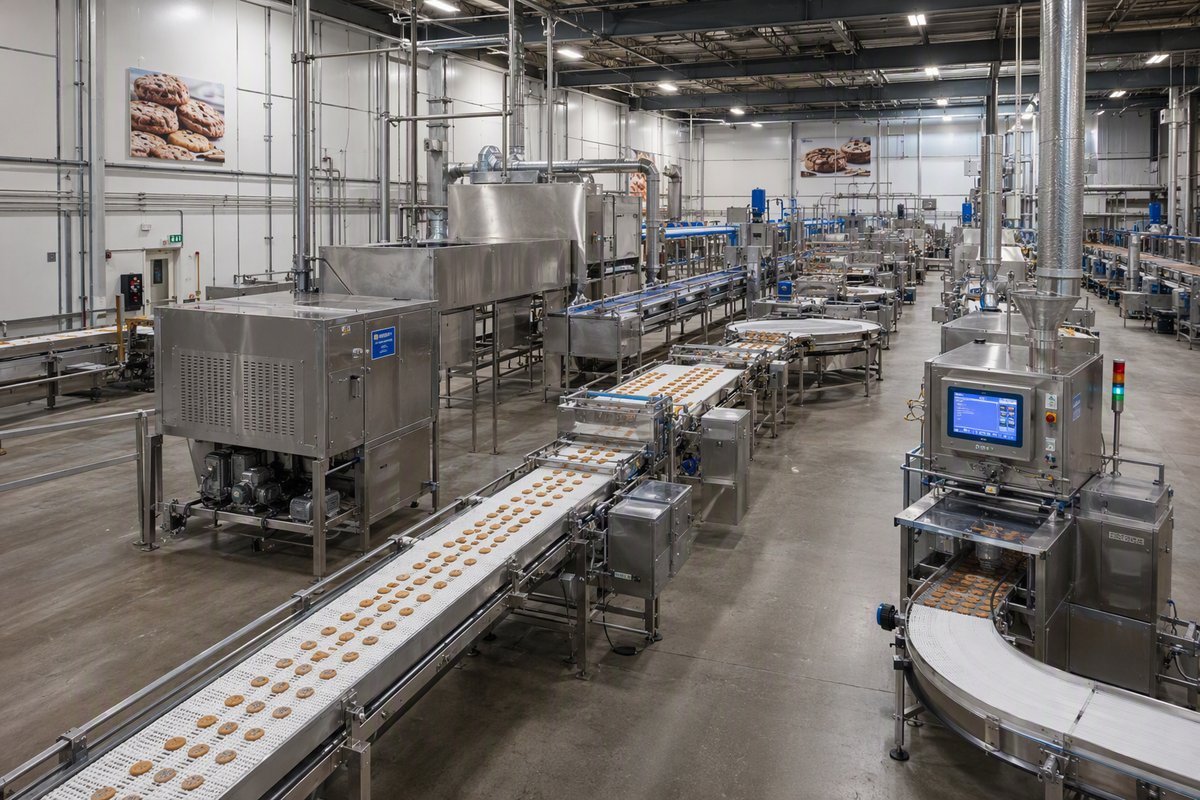
A food production line setup is the complete process of designing, equipping, and commissioning a coordinated system of machines, conveyors, workstations, and support infrastructure that transforms raw ingredients into finished food products. It encompasses equipment selection, spatial layout, utility planning, workflow design, quality control integration, and personnel organization. The goal is to create a production system that is efficient, safe, scalable, and compliant with all applicable food safety regulations.
Food production lines vary enormously in scale and complexity. A small central kitchen may have a line with 3-5 machines processing 500 kg of product per day, while a large industrial food factory may have multiple integrated lines processing 50+ tons per day. The principles of good line design, however, are the same regardless of scale: maximize throughput, minimize waste, ensure food safety, maintain product consistency, and provide flexibility for future growth.
The food production line setup process is inherently multidisciplinary. It requires input from food technologists (product specifications and process requirements), mechanical engineers (equipment selection and integration), industrial designers (layout and workflow), food safety specialists (HACCP and regulatory compliance), and financial analysts (cost estimation and ROI). This guide synthesizes all these perspectives into a practical, actionable framework.
Key Components of a Food Production Line
Every food production line, regardless of the product being manufactured, consists of several functional zones. Understanding these zones is the foundation of effective line design:
1. Raw Material Receiving and Storage
This zone handles the intake, inspection, and storage of raw ingredients. It includes receiving docks, inspection stations, cold storage (for perishables), dry storage (for grains, spices, packaging materials), and inventory management systems. Proper design of this zone prevents cross-contamination between raw and finished products and ensures first-in-first-out (FIFO) inventory rotation.
2. Preparation and Pre-Processing
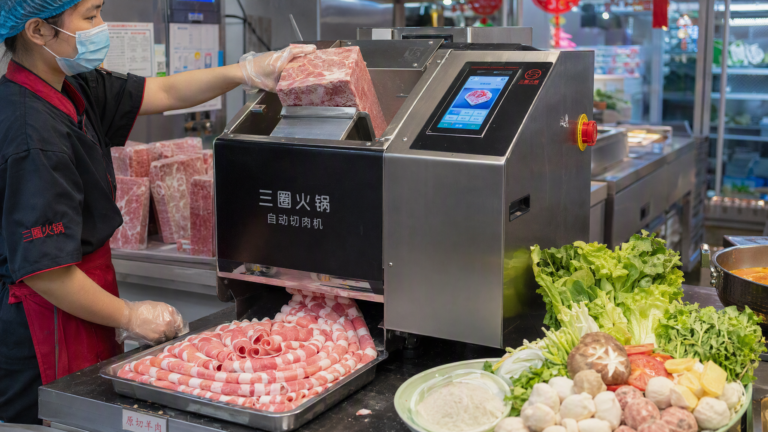
The preparation zone handles the initial processing of raw materials: washing, peeling, sorting, cutting, and portioning. This is where equipment like vegetable washing machines, peelers, Vegetable Cutting Machines, and Meat Slicer Machines are deployed. The preparation zone is typically the most labor-intensive part of the line and offers the greatest opportunity for automation-driven efficiency gains.
3. Processing and Cooking
The processing zone transforms prepared ingredients into the finished product. Depending on the product, this may include mixing, forming, cooking (steaming, boiling, frying, baking), cooling, and seasoning. Equipment in this zone is product-specific—a noodle production line uses a Noodle Making Machine, a bakery line uses a Commercial Dough Sheeter and Dough Divider Machine, and a dumpling line uses forming machines.
4. Quality Control and Inspection
Quality control stations are distributed throughout the line, not isolated at the end. In-line inspection may include metal detectors, checkweighers, vision systems for visual defect detection, and temperature monitoring. The QC zone ensures that non-conforming product is identified and removed before it reaches packaging.
5. Packaging and Labeling
The packaging zone handles the final steps: filling, sealing, labeling, coding, and case packing. Packaging equipment must be matched to the product format (tray, bag, pouch, bulk container) and the required shelf life (vacuum, MAP, standard). Packaging is often the bottleneck in a production line, so its throughput capacity must equal or exceed the processing zone’s output.
6. Finished Goods Storage and Dispatch
Finished products are transferred to finished goods storage—refrigerated, frozen, or ambient depending on the product—before dispatch. This zone must be physically separated from raw material storage to prevent cross-contamination.
Steps in Planning a Food Production Line Setup
A successful food production line setup follows a structured planning process. Skipping steps or making decisions out of order leads to costly mistakes. Here is the recommended sequence:
Step 1: Define Your Product and Process
Before selecting any equipment, you must have a clearly defined product specification and manufacturing process. Document the complete recipe, processing steps, parameters (temperature, time, pressure), and quality standards for each product you intend to manufacture. This product/process document is the foundation for all subsequent decisions. Without it, equipment selection is guesswork.
Step 2: Determine Production Capacity Requirements
Calculate your required production capacity based on market demand, sales forecasts, and business goals. Express capacity in both weight (kg per day) and units (packages per day). Consider:
- Current demand: Based on existing orders or market research
- Growth projection: Expected demand increase over 3-5 years
- Production schedule: Number of shifts per day, days per week
- Efficiency factor: Actual output is typically 70-85% of theoretical capacity due to setup, cleaning, changeovers, and minor stoppages
For example, if your target is 2,000 kg per day on a single 8-hour shift, your line must be rated for at least 2,000 / 8 / 0.75 = 333 kg per hour of theoretical capacity.
Step 3: Select Equipment for Each Process Step
Based on your product specification and capacity requirements, select equipment for each process step. For each machine, consider:
- Throughput: Must match or exceed the line’s target capacity
- Product compatibility: Can it handle your specific product (size, shape, temperature, moisture)?
- Changeover flexibility: How long does it take to switch between products?
- Cleaning requirements: How long does daily cleaning take? Is CIP available?
- Integration capability: Can it connect to upstream and downstream equipment via standard conveyors or interfaces?
- Spare parts and service: Is local support available?
Step 4: Design the Factory Layout
The physical layout of your production line determines material flow, worker efficiency, food safety, and expansion potential. Key layout principles include:
- One-way product flow: Raw materials enter at one end, finished products exit at the other. Never allow product flow to reverse or cross.
- Zoned separation: Physically separate raw material handling, processing, and packaging zones to prevent cross-contamination.
- Minimal handling: Each time product is handled or moved, you add labor cost and contamination risk. Design the layout to minimize product transfers.
- Adequate clearance: Provide sufficient space around each machine for operation, cleaning, and maintenance. A cramped line is difficult to clean and service.
- Utility access: Ensure water, power, steam, compressed air, and drainage are accessible at each machine location.
Step 5: Plan Utilities and Infrastructure
Food production requires significant utility infrastructure. Calculate the requirements for:
- Electrical power: Sum the power requirements of all machines plus lighting, HVAC, and refrigeration. Add 20% spare capacity.
- Water supply: Process water, cleaning water, and potable water may have different pressure and quality requirements.
- Steam: If any equipment uses steam, size the boiler accordingly with redundancy.
- Compressed air: Required for pneumatic equipment, valves, and cleaning. Must be oil-free for food-contact applications.
- Drainage: Floor drains must handle peak water usage. Use stainless steel trench drains with removable grates for cleaning.
- Ventilation and HVAC: Cooking processes generate heat and steam; refrigeration areas require temperature control. Design HVAC to maintain appropriate temperatures in each zone.
Step 6: Integrate Food Safety and Quality Control
Food safety must be designed into the line, not added as an afterthought. Integrate the following into your line setup:
- HACCP critical control points: Identify each CCP in your process and install monitoring equipment (temperature loggers, metal detectors, checkweighers) at those points.
- CIP (Clean-in-Place) systems: Where possible, use equipment with CIP capability to reduce cleaning time and improve sanitation consistency.
- Hygienic design: Choose equipment with smooth surfaces, minimal horizontal ledges, and sloped bottoms that drain freely. Avoid equipment with dead ends where product can accumulate.
- Pest control integration: Design the facility with pest exclusion features (air curtains, strip doors, sealed penetrations).
Equipment Selection by Product Category
Different food product categories require different equipment configurations. Here is an overview of common production line types:
Meat Processing Lines
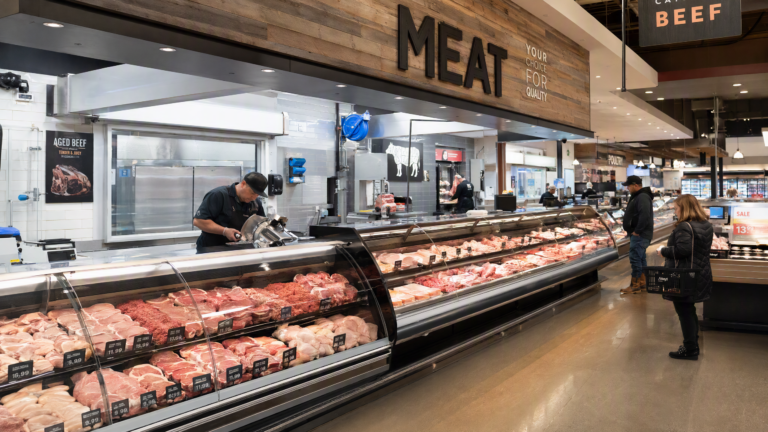
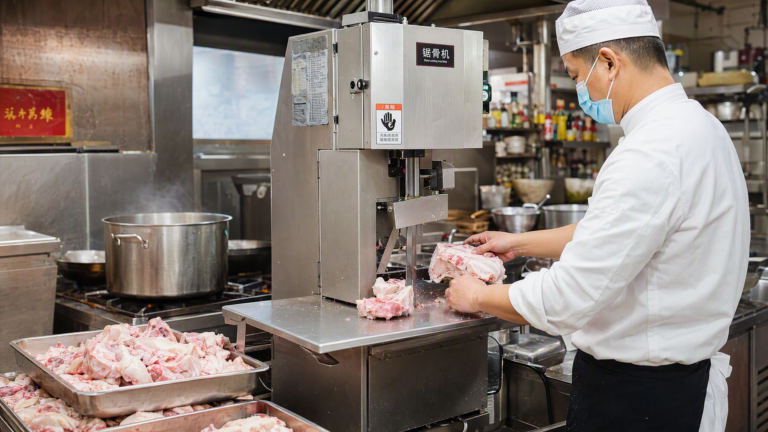
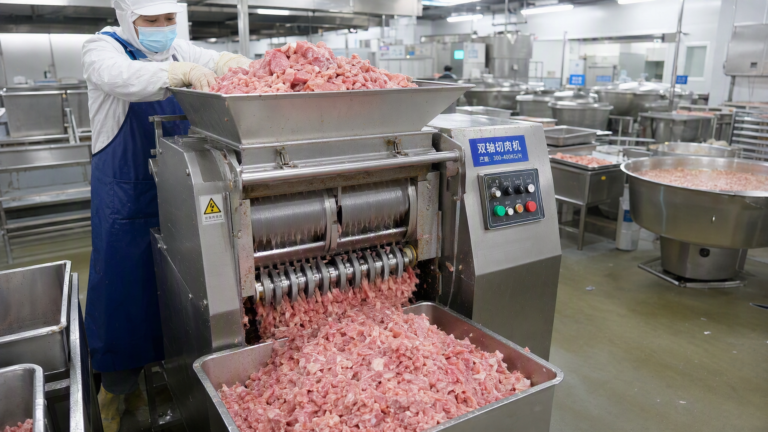
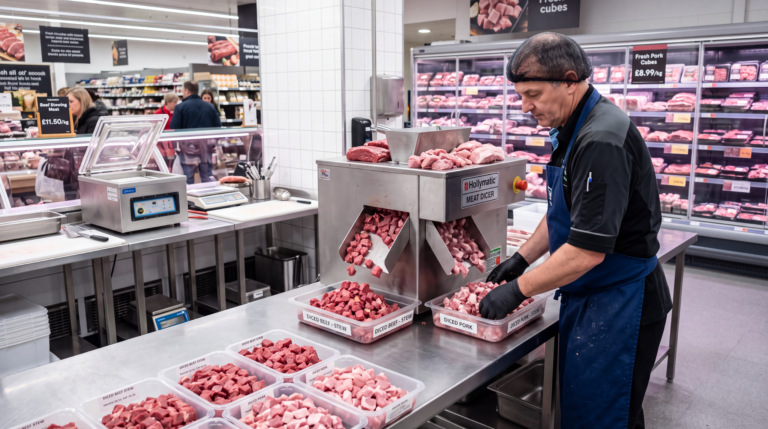
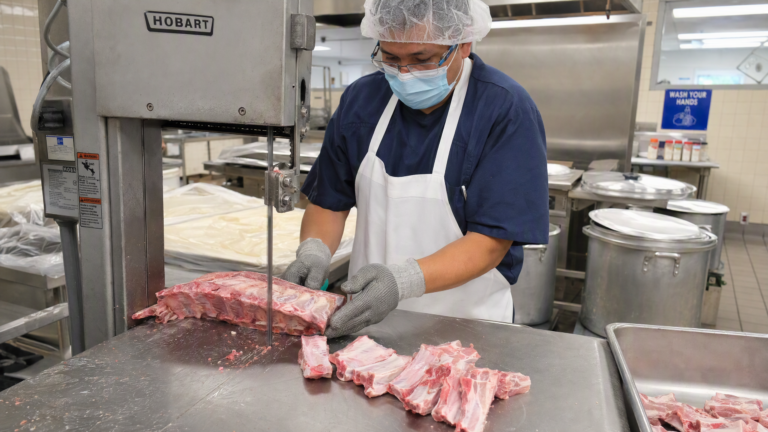
Meat processing lines handle slaughtering, cutting, slicing, dicing, and packaging of meat products. Key equipment includes bone saws, meat slicers, skinning machines, dicers, grinders, and packaging equipment. The line must be designed for cold operation (0-4°C) throughout, with stainless steel construction and high-pressure washdown capability. Meat processing has the most stringent food safety requirements of any food category due to the high microbial risk associated with raw meat.
Noodle and Dough Product Lines
Noodle production lines range from fresh noodle lines (mixing, sheeting, cutting, packaging) to dried noodle lines (adding drying tunnels) to instant noodle lines (adding frying or hot-air drying). Dough product lines for dumplings, steamed buns, and flatbreads use forming and filling equipment. The key challenge in noodle and dough lines is flour dust control and dough temperature management.
Vegetable Processing Lines
Vegetable processing lines handle washing, peeling, cutting, blanching, cooling, and packaging. The washing step is particularly important—root vegetables need brush washing, while leafy greens need bubble washing. Vegetable lines often include freezing equipment for frozen vegetable products. Water management is a critical design consideration due to the high water usage of washing equipment.
Convenience Food and Ready Meal Lines
Ready meal lines combine multiple ingredient streams—meat, vegetables, sauces—into a finished packaged meal. These lines are the most complex, requiring synchronized feeding of multiple components, cooking, filling, sealing, and chilling or freezing. The line design must accommodate recipe changes and product variety without lengthy changeover times.
Food Production Line Equipment Comparison Table
The following table compares key equipment categories typically found in food production lines, helping you understand their roles and selection criteria:
| Equipment Category | Function | Typical Throughput | Key Selection Criteria |
| Washing/Cleaning | Remove soil, contaminants, microbes | 200-5,000 kg/hr | Washing method vs. product type; water recirculation; sanitizing capability |
| Cutting/Slicing/Dicing | Size reduction and portioning | 100-1,000 kg/hr | Cut size range; product type; blade material; automation level |
| Mixing/Blending | Combine ingredients uniformly | 50-2,000 kg/batch | Batch vs. continuous; mixing action; sanitation design |
| Forming/Portioning | Shape product into final form | 500-10,000 pcs/hr | Product shape; weight accuracy; changeover time |
| Cooking (steam/boil/fry) | Apply heat to cook product | 100-3,000 kg/hr | Heating method; temperature control; energy efficiency |
| Cooling/Chilling | Reduce product temperature | 100-3,000 kg/hr | Cooling method; time-temperature profile; capacity |
| Packaging | Fill, seal, label, code | 50-500 ppm | Package format; shelf life tech; integration capability |
| Inspection (metal/x-ray) | Detect contaminants | 50-500 ppm | Detection sensitivity; product effect; rejection mechanism |
Capacity Planning and Bottleneck Analysis
One of the most critical aspects of food production line setup is ensuring that the line is balanced—that no single machine creates a bottleneck that limits overall throughput. A production line is only as fast as its slowest machine, so capacity planning must consider the entire line, not individual machines in isolation.
How to Identify Bottlenecks
Start by listing every machine in the line with its rated throughput. Convert all throughputs to a common unit (e.g., kg per hour). The machine with the lowest throughput is your primary bottleneck. There are two strategies to address a bottleneck:
- Increase the bottleneck machine’s capacity: Upgrade to a faster model, add a second machine in parallel, or optimize the existing machine’s operation.
- Reduce throughput of non-bottleneck machines: If a non-bottleneck machine is significantly faster than the bottleneck, it will produce excess inventory that accumulates between machines. Slowing it down (or running it fewer hours) reduces waste and energy consumption without reducing overall line output.
Buffer Zones
Even in a well-balanced line, minor stoppages are inevitable—a machine needs a brief adjustment, a blade is changed, or a cleaning cycle runs. Buffer zones (accumulation conveyors or holding bins) between machines absorb these short interruptions so that downstream machines can continue running. Size buffer zones based on the expected duration and frequency of stoppages at each machine.
Changeover Time
If your line produces multiple products, changeover time—the time required to switch from one product to another—is a critical factor in overall line utilization. A line that runs 8 hours per day but loses 2 hours to changeovers has only 75% utilization. Design your line and select equipment to minimize changeover time through quick-change parts, programmable recipes, and tool-less disassembly.
Cost Estimation for Food Production Line Setup
Accurately estimating the cost of a food production line setup is essential for securing financing and evaluating project viability. Costs fall into several categories:
1. Equipment Costs
This is typically the largest single cost category. It includes all processing machines, conveyors, inspection equipment, packaging machines, and utility equipment (boilers, compressors, chillers). Equipment costs vary enormously based on scale, automation level, and brand. As a rough guideline:
- Small line (500 kg/day): $20,000-$80,000
- Medium line (2,000 kg/day): $80,000-$300,000
- Large line (10,000+ kg/day): $300,000-$2,000,000+
2. Facility Construction or Renovation
If you are building a new facility or renovating an existing one, construction costs include flooring (epoxy or anti-slip food-grade), walls (washable panels), ceiling systems, drainage, lighting, HVAC, and clean room capability if required. Food-grade facility construction costs $300-$1,000 per square meter depending on the level of finish and regulatory requirements.
3. Utility Infrastructure
Installing or upgrading electrical, water, steam, compressed air, and drainage systems to support the production line. This is often underestimated. Budget 15-25% of equipment cost for utility infrastructure.
4. Installation and Commissioning
Shipping, rigging, installation labor, electrical and mechanical integration, programming, and commissioning. Budget 10-20% of equipment cost.
5. Training and Documentation
Operator training, maintenance training, SOP development, and HACCP documentation. Budget $5,000-$30,000 depending on line complexity.
6. Working Capital
Initial raw material inventory, packaging material inventory, and the first 2-3 months of operating expenses before revenue stabilizes. This is frequently overlooked and can derail an otherwise well-planned project.
Total Cost Summary Table
| Cost Category | Small Line | Medium Line | Large Line |
| Equipment | $20K-$80K | $80K-$300K | $300K-$2M+ |
| Facility Construction | $10K-$50K | $50K-$200K | $200K-$1M+ |
| Utility Infrastructure | $5K-$20K | $15K-$60K | $50K-$300K |
| Installation & Commissioning | $3K-$15K | $10K-$50K | $30K-$200K |
| Training & Documentation | $2K-$5K | $5K-$15K | $15K-$30K |
| Total (Approximate) | $40K-$170K | $160K-$625K | $595K-$3.5M+ |
Note: These are rough estimates for planning purposes only. Actual costs vary significantly based on location, product type, automation level, and regulatory requirements. Always obtain detailed quotes from equipment manufacturers and construction contractors before finalizing your budget.
Food Safety and Regulatory Compliance
Food safety is not optional—it is a legal requirement and a business survival issue. Your food production line setup must incorporate compliance with applicable regulations from the planning stage:
HACCP (Hazard Analysis and Critical Control Points)
HACCP is the internationally recognized food safety management system. Your production line must be designed to support HACCP implementation:
- Identify all biological, chemical, and physical hazards in your process
- Determine critical control points (CCPs) where hazards can be prevented, eliminated, or reduced
- Install monitoring equipment at each CCP (temperature sensors, metal detectors, pH meters)
- Design the line to facilitate monitoring and record-keeping
Regulatory Standards by Market
- China: GB (Guobiao) standards for food safety, SC (Shengchan) production license
- United States: FDA regulations, FSMA (Food Safety Modernization Act), USDA for meat products
- European Union: EFSA standards, CE marking for equipment, BRCGS or IFS certification for retail supply
- International: ISO 22000, FSSC 22000, Global G.A.P. for agricultural inputs
Equipment Certification Requirements
All food-contact equipment must meet material safety standards. In the US, this means FDA-compliant materials; in the EU, materials must meet EC 1935/2004 and the machine must carry CE marking. Request material certificates from equipment manufacturers and verify that food-contact surfaces are made from approved grades of stainless steel, plastics, and elastomers.
Best Practices for Food Production Line Setup
Based on real-world experience, the following best practices will help you avoid common pitfalls and achieve a successful production line setup:
1. Start with the Product, Not the Equipment
The most common mistake is selecting equipment before fully defining the product specification and manufacturing process. Every equipment decision should flow from the product requirements. A beautiful machine that cannot produce your product to specification is a waste of capital.
2. Plan for Cleaning from Day One
Cleaning is a daily, non-negotiable activity in food production. Design the line with cleaning in mind: sloped floors for drainage, accessible equipment with tool-free disassembly, CIP systems where possible, and dedicated cleaning stations. A line that is difficult to clean will suffer from food safety failures, reduced uptime, and high labor costs.
3. Build in Redundancy for Critical Equipment
Identify the machines whose failure would stop the entire line. For critical equipment, consider redundant units or at minimum ensure that spare parts are on hand and maintenance staff are trained to perform rapid repairs. The cost of a backup machine is often justified by the cost of a single day of unplanned downtime.
4. Design for Scalability
Your production line should be designed to accommodate growth. Leave physical space for additional machines, size utilities with spare capacity, and choose equipment that can be upgraded or supplemented rather than replaced. Modifying a line is far cheaper than building a new one.
5. Invest in Operator Training
Even the best equipment produces poor results if operated incorrectly. Invest in comprehensive operator training—both initial training during commissioning and ongoing training as staff turnover occurs. Develop clear, illustrated standard operating procedures (SOPs) for every machine and process step.
6. Implement Data Collection from the Start
Modern food production lines generate valuable data—throughput, downtime, temperature logs, quality measurements. Install data collection systems from day one. This data enables continuous improvement, supports food safety traceability, and provides the evidence needed for regulatory audits.
7. Don’t Forget the People
A production line is operated by people. Design workstations ergonomically, provide adequate lighting and ventilation, ensure safe access to all equipment, and create a positive working environment. Worker safety and comfort directly impact product quality and production efficiency.
Common Mistakes in Food Production Line Setup
- Underestimating utility requirements: Equipment needs power, water, steam, and drainage that exceed typical facility capacity. Always calculate utility loads before finalizing equipment selection.
- Ignoring changeover time: If you produce multiple products, changeover time can consume 20-30% of your available production time. Design the line for rapid changeover.
- Over-automating: Automation is valuable, but over-automating a line that does not have the volume to justify it wastes capital and adds complexity. Match automation level to production volume.
- Neglecting the packaging zone: Packaging is often the bottleneck. Ensure packaging equipment capacity matches or exceeds processing capacity.
- Not planning for waste: Food production generates waste—trimmings, rejects, wash water. Plan waste handling and treatment systems from the beginning.
- Buying cheap equipment: In food production, equipment reliability and sanitation design are worth paying for. Cheap equipment that breaks down frequently or is difficult to clean costs more in the long run.
Conclusion
A successful food production line setup is the result of careful planning, informed equipment selection, thoughtful layout design, and rigorous attention to food safety and quality. By following the structured approach outlined in this guide—defining your product, calculating capacity, selecting equipment for each process step, designing an efficient layout, planning utilities, integrating food safety, and estimating costs accurately—you can build a production line that meets your current needs and scales with your business growth.
The most important principles to remember are: start with the product specification, balance the line to eliminate bottlenecks, design for cleaning and food safety from the beginning, plan for scalability, and invest in training and data collection. When you follow these principles and work with experienced equipment suppliers who understand your product and market, your food production line will deliver consistent quality, efficient operation, and a strong return on investment for years to come.