Professional Food Processing Machinery Manufacturer
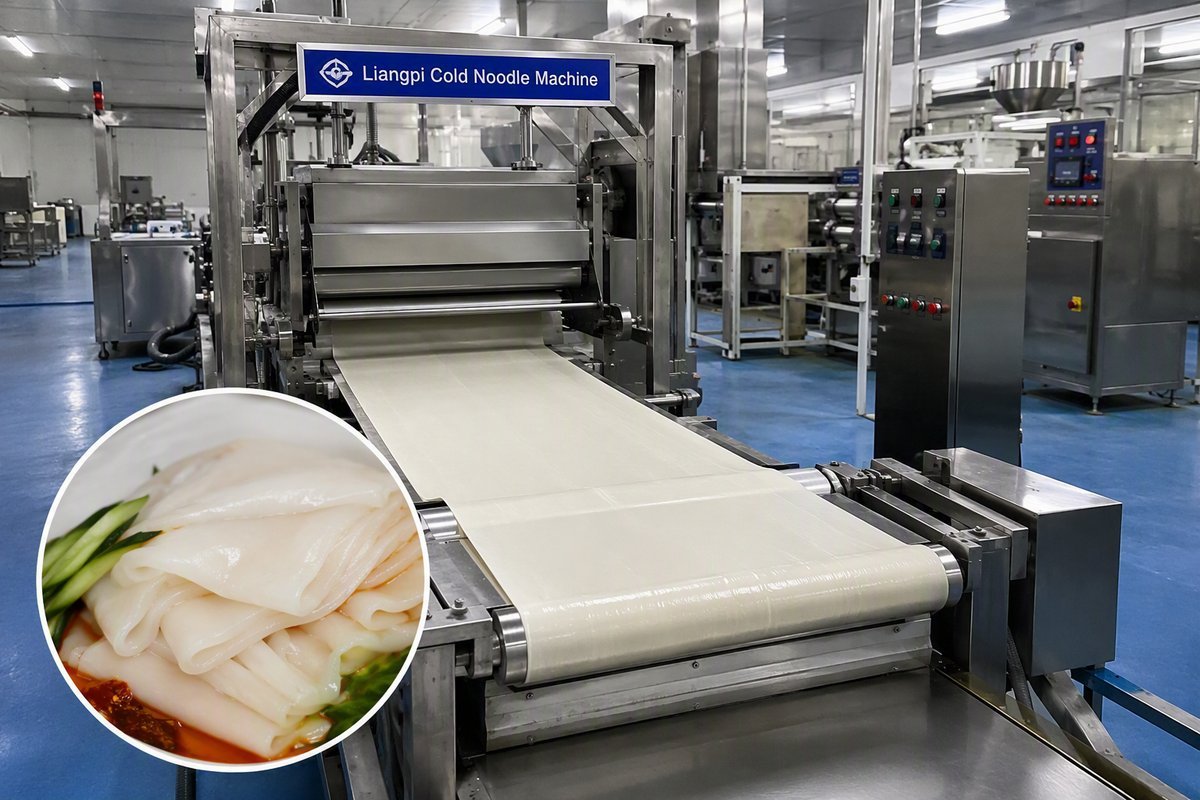

Cold Noodle Machine: Complete Guide to Liangpi and Cold Noodle Production — learn how Yuerui Machinery supports your production with reliable equipment and engineering.
Cold noodles—known as liangpi in Chinese—are one of the most popular street foods and restaurant dishes across Asia, and their popularity is spreading rapidly to international markets. A cold noodle machine is the specialized equipment that makes commercial-scale liangpi production possible, transforming a laborious traditional process into an efficient, automated operation. For food entrepreneurs, central kitchens, and noodle manufacturers looking to enter or expand in the cold noodle market, understanding how a cold noodle machine works and what to look for when buying one is the key to building a profitable production line.
This complete guide covers the cold noodle production process, the types of machines available, key specifications, business planning considerations, maintenance practices, and buying advice. Whether you are starting a small liangpi business or scaling up an existing noodle production operation, this guide will help you make informed equipment decisions.
What Is a Cold Noodle Machine?
A cold noodle machine is a specialized piece of food processing equipment designed to produce liangpi—a type of cold noodle made from wheat or rice starch rather than whole flour. Unlike regular noodles that are made by sheeting and cutting dough, liangpi is made by steaming a thin layer of starch batter into a smooth, translucent sheet, then cutting the sheet into strips. A cold noodle machine automates this process, handling the batter spreading, steaming, cooling, and cutting steps in a continuous or semi-continuous operation.
The traditional liangpi-making process is entirely manual: wash dough in water to separate starch from gluten, let the starch settle, pour the starch liquid onto a flat pan, steam it, peel off the cooked sheet, cool it, and cut it by hand. This process takes hours, requires significant skill, and produces inconsistent results. A cold noodle machine reduces the entire process to minutes, produces consistent quality, and can output hundreds of portions per hour with minimal labor.
The market for cold noodles extends well beyond China. Korean cold noodles (naengmyeon), Japanese chilled somen, Vietnamese bun, and Southeast Asian rice noodle dishes all share similar production principles. A versatile cold noodle machine can often be adapted for multiple product types, making it a valuable investment for producers serving diverse Asian cuisine markets.
How a Cold Noodle Machine Works
The cold noodle production process is fundamentally different from regular noodle production. Here is a detailed breakdown of how a cold noodle machine transforms raw starch into finished liangpi:
Step 1: Starch Batter Preparation
The first step is preparing the starch batter. Wheat starch (or rice starch, depending on the product) is mixed with water to form a smooth, lump-free liquid batter. The starch-to-water ratio is critical—it determines the thickness, texture, and transparency of the finished liangpi. Typical ratios range from 1:2 to 1:3 (starch to water by weight). Some cold noodle machines include an integrated batter mixing system, while others require the batter to be prepared separately in a mixing tank.
Step 2: Batter Spreading
The starch batter is spread onto a flat cooking surface—typically a metal conveyor belt or a rotating drum. The machine controls the volume of batter deposited and the spreading thickness to ensure uniform liangpi sheets. This is one of the most critical steps in the process: too much batter produces thick, gummy liangpi; too little produces thin, fragile sheets that tear during handling.
Step 3: Steaming
The batter-coated surface passes through a steaming chamber where steam heat cooks the starch batter into a solid, translucent sheet. Steaming temperature and time must be precisely controlled—typically 95-100°C for 30-90 seconds depending on sheet thickness. Under-cooking produces a sticky, raw-tasting product, while over-cooking makes the sheet brittle and prone to cracking. Modern cold noodle machines use thermostatically controlled steam chambers that maintain consistent cooking conditions.
Step 4: Cooling
After steaming, the hot liangpi sheet must be cooled before it can be handled and cut. The machine conveys the sheet through a cooling section, which may use ambient air, forced air, or a water spray. Proper cooling is essential—it sets the texture of the liangpi, giving it the characteristic smooth, chewy, and slightly elastic mouthfeel. Rapid cooling produces a firmer texture; slow cooling produces a softer product.
Step 5: Cutting
The cooled liangpi sheet is cut into strips of the desired width. Most machines use rotating cutting blades or a slitting mechanism that produces strips of uniform width. Strip width is adjustable—typically 3mm to 15mm—to accommodate different serving styles. Some machines also include a cross-cutting mechanism that produces rectangular pieces for certain liangpi styles.
Step 6: Discharge and Collection
The finished liangpi strips are discharged from the machine and collected for packaging or further processing. At this stage, the product is ready to be dressed with sauce and served, or packaged for distribution. The entire process from batter to finished strips takes approximately 2-5 minutes per batch, depending on the machine.
Types of Cold Noodle Machines
Cold noodle machines come in several configurations, each designed for different production scales and product requirements. Understanding these types will help you select the right machine for your business.
1. Manual-Semi-Automatic Cold Noodle Machines
These entry-level machines handle the steaming and basic cutting functions but require significant operator involvement for batter preparation, loading, and product handling. They are compact, affordable, and suitable for small restaurants, food stalls, and startup businesses producing 50-100 kg of liangpi per hour. The operator pours batter onto the cooking surface, monitors the steaming process, and manually removes and cuts the finished sheets. While labor-intensive, these machines are an accessible entry point into commercial liangpi production.
2. Fully Automatic Cold Noodle Machines
Fully automatic machines handle the entire process from batter spreading through cutting with minimal operator intervention. The operator simply maintains the batter supply and collects the finished product. These machines feature conveyor or drum systems that continuously produce liangpi sheets, steam them, cool them, and cut them into strips. Throughput ranges from 100 to 300 kg per hour. The Multi-functional Cold Noodle Machine from Yuerui Machinery is an example of this type, offering automated production with adjustable sheet thickness and strip width.
3. Multi-Functional Cold Noodle Machines
Multi-functional machines are designed to produce not only liangpi but also related products such as rice noodles, flat rice noodles (hefen), sheet jelly (mianpi), and other starch-based noodle products. These machines achieve versatility through adjustable parameters (batter thickness, steaming time, cutting width) and interchangeable components. For businesses serving diverse markets or experimenting with new products, a multi-functional machine provides maximum return on investment through product flexibility.
4. Large-Scale Industrial Cold Noodle Production Lines
For large-scale manufacturers producing liangpi for retail distribution, frozen food companies, or food service supply chains, industrial-scale production lines integrate batter mixing, sheet forming, steaming, cooling, cutting, packaging, and optionally pasteurization or modified atmosphere packaging. These lines can produce 500-2,000 kg per hour and represent a significant capital investment. They are typically custom-designed for the specific product and packaging requirements of the manufacturer.
Key Specifications to Consider
When evaluating a cold noodle machine, the following specifications are critical:
- Production capacity: Measured in kg per hour or sheets per hour. Match capacity to your daily sales volume with 20-30% growth headroom. Remember that actual output may be 70-85% of the rated capacity due to setup time, batter preparation, and cleaning.
- Sheet thickness range: Typically adjustable from 0.5mm to 3mm. Thinner sheets cook faster and have a more delicate texture; thicker sheets are chewier and more filling. The ability to adjust thickness allows you to produce different product styles on the same machine.
- Strip width range: Typically 3mm to 15mm adjustable. Different regional styles of liangpi call for different strip widths—some prefer wide, flat strips, while others prefer thin, round ones.
- Steam consumption: A significant operating cost. Check the machine’s steam consumption rate (kg of steam per kg of product) and ensure your facility has adequate steam generation capacity. Some machines use electric heating instead of steam, which simplifies installation but increases energy costs.
- Heating method: Steam heating is the traditional and most efficient method. Electric heating is simpler to install and suitable for smaller machines. Gas heating is an option in some regions where gas is inexpensive. Choose the method that aligns with your facility’s utilities and operating cost targets.
- Motor power: Typically ranges from 1.5kW for compact machines to 7.5kW+ for industrial models. Includes motors for the conveyor/drum drive, cutting mechanism, and fans.
- Material construction: 304 food-grade stainless steel for all food-contact surfaces. The cooking surface in particular must be high-quality stainless steel to ensure even heat distribution and prevent sticking.
- Automation features: Look for automatic batter spreading, thermostatic steam control, automatic cutting width adjustment, and conveyor speed control. These features reduce operator dependency and improve product consistency.
- Cleaning accessibility: The machine must be easy to clean daily. Look for tool-free disassembly of the batter hopper, cooking surface, and cutting mechanism. Starch residue hardens quickly and is difficult to remove if not cleaned promptly.
- Footprint: Cold noodle machines range from 1 m² for compact models to 10+ m² for industrial lines. Measure your available space including clearance for batter preparation, product collection, and maintenance access.
Cold Noodle Machine Comparison Table
The following table compares the main types of cold noodle machines to help you identify the right category for your business:
| Feature | Manual Semi-Auto | Fully Automatic | Multi-Functional | Industrial Line |
| Capacity (kg/hr) | 50-100 | 100-300 | 100-250 | 500-2,000 |
| Automation Level | Manual loading, auto steam/cut | Continuous automatic | Continuous automatic | Fully automated line |
| Sheet Thickness (mm) | 1-3 | 0.5-3 | 0.5-3 | 0.5-3 |
| Heating Method | Electric or steam | Steam or electric | Steam or electric | Steam (industrial boiler) |
| Motor Power (kW) | 1.5-2.2 | 2.2-5.5 | 3.0-5.5 | 7.5-15+ |
| Product Types | Liangpi only | Liangpi, mianpi | Liangpi, rice noodle, hefen | Multiple starch noodles |
| Operators Required | 1-2 | 1 | 1 | 2-3 |
| Footprint (m²) | 1-2 | 3-5 | 3-6 | 10-30 |
| Ideal For | Restaurants, food stalls | Small factories, central kitchens | Diverse product producers | Large-scale manufacturers |
| Price Range (USD) | $1,500-$5,000 | $5,000-$15,000 | $6,000-$18,000 | $20,000-$80,000+ |
Applications and Use Cases
Cold noodle machines serve a diverse range of businesses. Here are the most common applications:
Restaurant and Food Service Supply
Restaurants specializing in cold skin noodles (liangpi shops), Asian fusion restaurants, and food courts need a reliable supply of fresh liangpi. While small restaurants may make liangpi in-house using a compact cold noodle machine, larger chains and food service operators purchase from centralized production facilities. A fully automatic cold noodle machine producing 200-300 kg per hour can supply dozens of restaurant locations with daily fresh liangpi.
Central Kitchen Operations
Central kitchens that supply restaurant chains, institutional cafeterias, and meal delivery services increasingly include cold noodles in their product range. A cold noodle machine integrated into a central kitchen production line can produce fresh liangpi alongside other noodle products. The Noodle Making Machine and cold noodle machine can work in tandem—one producing regular wheat noodles and the other producing liangpi—giving the central kitchen a complete noodle product portfolio.
Retail and Supermarket Supply
There is growing demand for packaged, ready-to-eat cold noodles in supermarkets and convenience stores. These products require consistent quality, attractive appearance, and adequate shelf life. Producers supplying retail channels need cold noodle machines with high throughput and consistent product quality, often combined with modified atmosphere packaging to extend shelf life.
Frozen Food Manufacturing
Frozen liangpi and cold noodle meal kits are an emerging product category. Freezing liangpi requires careful control of the production process—sheet thickness, moisture content, and cooling rate all affect how well the product survives freezing and thawing. Industrial cold noodle production lines with precise parameter control are essential for producing freezer-grade liangpi.
International Market Expansion
As Asian cuisine gains popularity worldwide, cold noodle producers in China and other Asian countries are exporting liangpi to North America, Europe, and Southeast Asia. Export-grade production requires consistent quality, food safety compliance (HACCP, FDA registration for US market, etc.), and the ability to produce products that meet international standards. A high-quality cold noodle machine is the foundation of an export-ready production facility.
How to Start a Cold Noodle Business
For entrepreneurs considering entering the cold noodle market, here is a practical framework for starting a liangpi production business:
1. Market Research and Product Definition
Research the local market for cold noodles. Who are your target customers—restaurants, supermarkets, food service operators, or direct consumers? What liangpi styles are in demand (traditional wheat starch, rice-based, flavored varieties)? Understanding your market determines your product specification, which in turn determines your equipment requirements.
2. Production Scale Planning
Determine your initial daily production volume based on realistic market demand. A common mistake is over-investing in capacity that exceeds market demand. Start with a machine that meets your confirmed orders plus 30-50% growth headroom. You can always upgrade to a larger machine as demand grows.
3. Recipe and Process Development
Before investing in a machine, develop and perfect your liangpi recipe. The starch source (wheat, rice, or blend), starch-to-water ratio, and any additives (salt, oil, modified starch) all affect the final product. Test your recipe on a small scale first—many machine manufacturers offer sample production runs using your recipe before you commit to a purchase.
4. Facility and Utility Preparation
Prepare a food-grade production facility with adequate space, water supply, drainage, ventilation, and steam or electrical capacity. Cold noodle production generates significant steam, so ventilation is particularly important. Ensure the facility meets local food production licensing requirements.
5. Equipment Selection and Purchase
Based on your production scale, product specification, and facility constraints, select a cold noodle machine that meets your requirements. Consider not just the machine itself but also auxiliary equipment: batter mixing tanks, steam generators (if not included), packaging equipment, and refrigeration for product storage.
6. Quality Control and Food Safety
Implement a quality control system covering raw material inspection, process parameter monitoring, and finished product testing. Cold noodles are a high-moisture product with a short shelf life, so microbial control is critical. Implement HACCP principles and obtain necessary food safety certifications for your target market.
Maintenance Tips for Cold Noodle Machines
Cold noodle machines work with starch batter that hardens rapidly when it dries, making daily cleaning essential. Proper maintenance ensures food safety, product quality, and equipment longevity.
Daily Maintenance
- Clean immediately after production: Starch residue hardens within 30-60 minutes after the machine stops. Disassemble and clean all food-contact components—batter hopper, spreading mechanism, cooking surface, cutting blades—immediately after each production run. Use warm water and food-grade detergent.
- Clean the cooking surface thoroughly: The cooking surface (conveyor or drum) must be spotless. Any residue causes sticking and uneven cooking in the next production run. Use a non-abrasive scrubber to avoid scratching the stainless steel surface.
- Inspect the cutting blades: Check for dullness, nicks, or starch buildup. Dull blades tear the liangpi instead of cutting cleanly. Sharpen or replace as needed.
- Clean the steam chamber: If using a steam-heated machine, drain and flush the steam chamber to remove condensate and any product residue that entered through steam ports.
- Sanitize all food-contact surfaces: After cleaning, sanitize with an approved food-contact sanitizer to prevent bacterial growth, particularly in the cooling and cutting sections where product temperatures are favorable for microbial growth.
Weekly Maintenance
- Deep clean non-food-contact components: Remove side panels and clean the machine frame, motor housings, and conveyor undersides where starch splatter can accumulate.
- Check conveyor belt or drum surface: Inspect for wear, warping, or surface damage. A damaged cooking surface produces uneven liangpi and is difficult to clean.
- Lubricate bearings and drive components: Apply food-grade lubricant to conveyor bearings, drum support bearings, cutting blade shafts, and any other moving parts. Starch dust is abrasive and accelerates wear on unlubricated components.
- Inspect steam lines and valves: Check for leaks, blockages, and proper valve operation. Steam system problems cause uneven heating and inconsistent product quality.
Monthly Maintenance
- Check the batter pump and piping: If the machine has an automatic batter delivery system, inspect the pump, valves, and piping for wear, blockages, and leaks. Starch settles and can clog piping if not properly flushed.
- Calibrate temperature controls: Verify that the steaming chamber temperature matches the controller setpoint using a calibrated thermometer. Temperature drift causes product quality issues that are difficult to diagnose.
- Inspect electrical components: Check for moisture ingress in control panels, damaged wiring, and loose connections. The high-humidity environment is harsh on electrical systems.
- Review production records: Track product quality metrics (sheet thickness, strip width, texture) over time to identify gradual drift that may indicate wear or calibration issues.
Buying Guide: How to Choose the Right Cold Noodle Machine
1. Match Machine Type to Your Business Model
A restaurant or food stall needs a compact, affordable machine; a central kitchen needs a fully automatic machine; a retail supplier needs an industrial production line. Define your business model first, then match the machine type to it. Buying a machine that is too large wastes capital; buying one that is too small limits your growth.
2. Verify Product Quality with a Demonstration
Before purchasing, request a demonstration using your own recipe and starch source. Evaluate the liangpi for thickness consistency, transparency, texture, and taste. If the manufacturer cannot provide a demonstration, request samples produced on the machine you are considering. Never buy a cold noodle machine based on specifications alone—actual product quality is the ultimate test.
3. Evaluate Versatility vs. Specialization
If you plan to produce only liangpi, a dedicated machine is the most cost-effective choice. If you want to produce multiple starch-based products (rice noodles, hefen, mianpi), a multi-functional machine provides better value despite its higher purchase price. Consider your current and future product plans carefully.
4. Consider Heating Method Carefully
Steam heating provides the most consistent and efficient cooking but requires a steam generator or boiler, which adds cost and complexity. Electric heating is simpler to install and suitable for smaller machines but has higher per-unit energy costs. If you already have a steam supply in your facility, steam heating is the clear choice. If not, factor in the cost of a steam generator when comparing options.
5. Assess After-Sales Support and Training
Cold noodle machines require specialized knowledge to operate and maintain. Choose a manufacturer that provides comprehensive operator training, clear documentation, responsive technical support, and readily available spare parts. Ask about remote diagnostics capabilities and whether the manufacturer can provide process optimization support as you scale up production.
6. Calculate Return on Investment
Estimate your revenue based on daily production volume and wholesale/retail price per kg of liangpi. Subtract your costs: raw materials (starch, water, additives), energy (steam or electricity), labor, packaging, facility overhead, and equipment depreciation. A well-run cold noodle business typically achieves break-even on equipment investment within 6-18 months, depending on production scale and market pricing.
Common Mistakes to Avoid
- Skipping recipe development before buying: A machine cannot compensate for a poor recipe. Develop and test your recipe before investing in equipment.
- Underestimating the importance of starch quality: The quality of your starch directly determines the quality of your liangpi. Source high-quality starch from reliable suppliers and test each batch before production.
- Neglecting daily cleaning: Starch hardens quickly and is extremely difficult to remove once set. Skipping or delaying cleaning damages the machine and creates food safety risks.
- Ignoring shelf life limitations: Fresh liangpi has a very short shelf life (typically 24-48 hours refrigerated). If you plan to distribute beyond your local area, invest in packaging technology (MAP, vacuum, or freezing) that extends shelf life.
- Buying more capacity than the market demands: Over-capacity ties up capital and increases per-unit costs. Start with realistic capacity and upgrade as demand grows.
Conclusion
A cold noodle machine is the gateway to entering one of the fastest-growing segments of the Asian food market. By automating the traditional liangpi-making process, it enables consistent quality, high throughput, and the scalability needed to build a profitable cold noodle business. From compact machines for restaurants to industrial production lines for retail distribution, there is a cold noodle machine suited to every business scale and product requirement.
The key to success is matching the machine to your business model, verifying product quality through demonstrations, investing in proper recipe development, and maintaining rigorous cleaning and quality control practices. When you select the right cold noodle machine and operate it with skill and discipline, the cold noodle market offers excellent growth potential and a strong return on investment.