Professional Food Processing Machinery Manufacturer

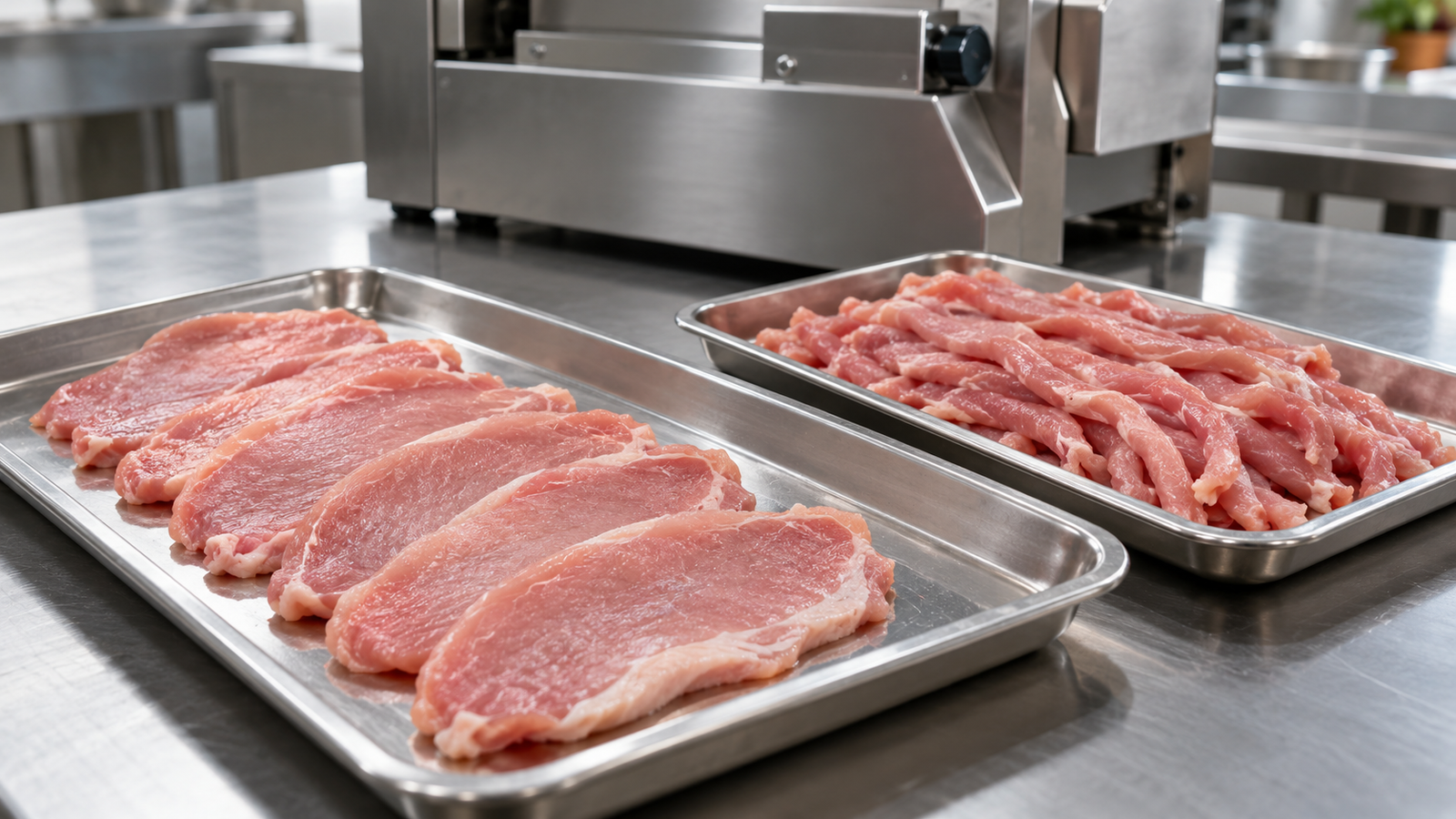

A fresh meat strip project may need to control more than the final strip width. Incoming meat thickness and the condition of the piece entering the strip cutter also belong in the specification. A proposed layering stage can be discussed, but its role should be demonstrated with the actual raw material rather than assumed from a drawing of two machines.
Describe the incoming meat
Record the cut, approximate shape, presence of connective tissue and the intended receiving condition. State explicitly whether bone is present. Provide representative samples rather than using one photograph to cover different cuts. Ask the supplier to confirm the raw-material limits of each proposed configuration before discussing a combined route.
The local Yuerui fresh-meat slicer introduction describes horizontal layering. The strip-cutter introduction describes fresh-meat strip cutting and lists separate conveying dimensions. These descriptions support discussing two operations; they do not prove a direct connection or a validated recipe for every meat product.
Specify the intermediate piece
Define what the layering stage should deliver to the next operation. Request confirmation of its shape, thickness and receiving arrangement. Then ask how that piece relates to the strip cutter's actual inlet and tooling. Do not treat a conveying dimension as a universal limit for every raw material without an engineering explanation.
Mark the transfer step on the scope sketch. If operators reorient or collect pieces, show that task. If a separately supplied conveyor is proposed, ask who confirms its design and how it will be evaluated. A quotation should identify these interfaces instead of presenting an unsupported continuous line.
Evaluate dimensions and handling together
Agree how the intermediate piece and final strip will be measured. Record the raw material, tooling and configuration with the observations. Keep any yield or damage assessment attached to a defined weighing or inspection method. Do not describe low loss, unchanged texture or a guaranteed output without records supporting those claims.
The enquiry should contain the incoming meat description, target strip and a proposed handoff. Ask Yuerui for separate confirmations of the layering and cutting stages, followed by a statement of what can be evaluated together. This gives the purchaser a clearer basis for comparing a single strip cutter with a broader preparation arrangement, without confusing the presence of two catalogue products with a proven integrated solution.
Define a common product reference for both stages
Use the same raw-material description when discussing layering and strip cutting. Identify which portion of the incoming piece is represented by the sample and how the desired finished strip is described. If the two machines are evaluated with different materials, retain that difference in the comparison. Separate demonstrations do not by themselves establish what happens when one stage supplies the other.
Ask the supplier to state which intermediate dimensions matter at the strip-cutter inlet. The answer should distinguish the tool specification from the conveying arrangement and any preparation expected before feeding. A dimension printed in a table should not be treated as a complete material approval without explaining what the field represents for that configuration.
Make the handoff visible in the equipment list
The commercial scope should identify any receiving containers, transfer items and supporting equipment needed between the two stages. If operators perform the handoff, show that task in the proposed workflow. If another vendor supplies a transfer system, identify who confirms its interfaces. This makes the comparison between a single machine and a broader preparation arrangement more meaningful.
Where the proposed site layout changes the receiving arrangement used in a demonstration, request a focused review of that change. A temporary demonstration table may help observe product output, but it does not establish a confirmed installation interface. The purchaser needs order-specific information about the arrangement that will actually be used.
Use observations to locate the next question
Record the condition of the layered piece before transfer and the strip after cutting. If a requested attribute is not achieved, the evidence should show which stage or boundary requires another discussion. Do not attribute an outcome to meat condition, a blade or a machine setting without supporting observations and the supplier's technical guidance.
The review should conclude with separate decisions about raw-material suitability, intermediate product definition and the final strip. Ask the supplier to connect those decisions to the quoted models and tools. This retains the distinction between a proposed two-stage route and a demonstrated combined workflow, without inventing a yield improvement or representing an untested equipment combination as a completed customer installation.