Professional Food Processing Machinery Manufacturer

Vegetable Washing Machine: Complete Guide for Food Processing — learn how Yuerui Machinery supports your production with reliable equipment and engineering.
In commercial food processing, washing is the first and most critical step in ensuring product safety and quality. A vegetable washing machine removes soil, debris, pesticide residues, and microbial contaminants from fresh produce before it moves to cutting, peeling, packaging, or freezing. For food processing facilities, central kitchens, and agricultural product distributors, investing in the right vegetable washing machine is not just about cleanliness—it is about protecting your brand, complying with food safety regulations, and maximizing product shelf life.
This complete guide covers everything you need to know about vegetable washing machines: how they work, the different types available, key specifications, washing technologies, maintenance practices, and a practical buying framework. Whether you are processing root vegetables, leafy greens, or delicate berries, this guide will help you select the equipment that matches your production needs and quality standards.
What Is a Vegetable Washing Machine?
A vegetable washing machine is an industrial-grade piece of equipment designed to clean vegetables and fruits using a combination of water, mechanical agitation, and sometimes sanitizing agents. Unlike household produce washers, commercial vegetable washing machines are built for continuous operation, handling hundreds to thousands of kilograms of produce per hour while meeting stringent food safety standards.
The washing process serves multiple critical functions beyond simple dirt removal. It removes field debris (stones, sticks, metal fragments), reduces microbial loads (bacteria, mold spores), washes away pesticide and chemical residues, and cools the product to extend shelf life. In many processing lines, the washing step also serves as a pre-selection stage where damaged or substandard product is identified and removed.
For B2B buyers—food factory owners, procurement managers, and production engineers—understanding the capabilities and limitations of different vegetable washing machine types is essential for making a sound capital investment. The wrong machine can damage delicate products, waste water, or fail to meet sanitation standards, while the right machine becomes a reliable, low-maintenance cornerstone of your processing line.
How a Vegetable Washing Machine Works
While designs vary by manufacturer and product type, most commercial vegetable washing machines operate on similar fundamental principles. Here is a breakdown of the typical washing process:
Stage 1: Product Infeed
Vegetables are loaded into the machine either manually, via a feed hopper, or by an upstream conveyor. The infeed system regulates the flow of product into the washing chamber to prevent overloading, which would reduce washing effectiveness. Some machines include a pre-soaking section where heavily soiled root vegetables are immersed in water to loosen compacted soil before entering the main wash chamber.
Stage 2: Mechanical Agitation
The core of the washing process is mechanical agitation—the physical action that dislodges soil and contaminants from the vegetable surface. Different machines use different agitation methods:
- Bubble agitation: Air bubbles rising through the water create turbulence that gently scrubs the vegetable surfaces. This method is ideal for delicate products like leafy greens and berries.
- Brush scrubbing: Rotating brushes physically scrub the vegetable surface. This is the most effective method for root vegetables with heavy soil, such as potatoes, carrots, and radishes.
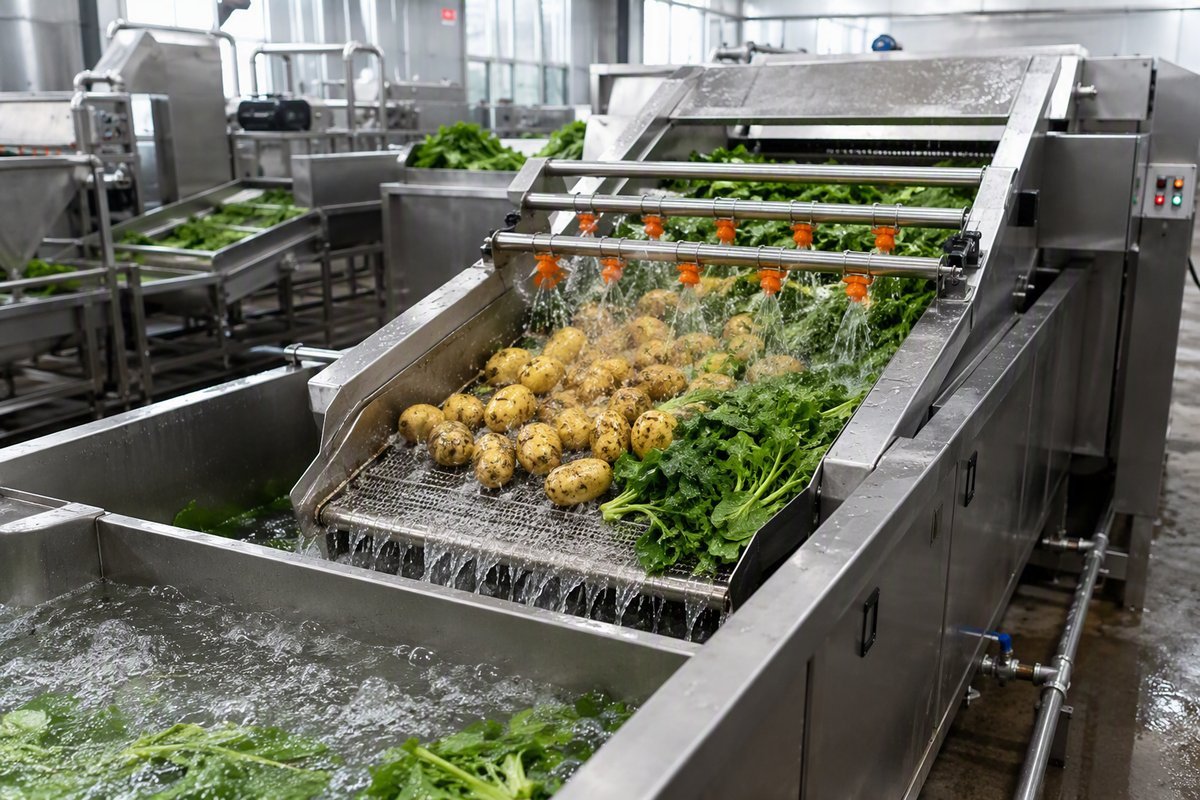
- Spray washing: High-pressure water jets spray the product from multiple angles. Spray washing is effective for products with irregular surfaces and is often combined with other methods.
- Drum rotation: The product tumbles inside a rotating perforated drum partially submerged in water. The tumbling action provides gentle, continuous agitation suitable for a wide range of products.
Stage 3: Sanitizing Rinse
After the primary wash, many machines include a sanitizing rinse stage. This may involve chlorinated water, ozone-treated water, or other approved sanitizing agents. The rinse reduces microbial loads to levels that comply with food safety standards and extends product shelf life. The concentration of sanitizing agent and contact time are carefully controlled to ensure effectiveness without leaving harmful residues.
Stage 4: De-watering and Drying
After washing, the product must be de-watered to prevent bacterial growth during storage and to prepare it for downstream processing (cutting, packaging, freezing). De-watering methods include:
- Vibrating sieve conveyors: The product passes over a vibrating mesh screen that allows water to drain while moving the product forward.
- Air-blowing systems: High-velocity air blows across the product surface to remove surface water. Effective for leafy vegetables and products with large surface areas.
- Centrifugal drying: The product is spun in a centrifuge to remove water. This method is very effective but can damage delicate products and is typically reserved for sturdy vegetables.
Stage 5: Discharge
The clean, de-watered product is discharged onto a conveyor for the next processing step. Meanwhile, the wash water is filtered, treated, and in many cases recirculated to reduce water consumption. Modern machines include multi-stage filtration systems that remove solids before the water is reused or discharged.
Types of Vegetable Washing Machines
Vegetable washing machines are categorized by their washing mechanism and the product types they are designed to handle. Here are the main types:
1. Bubble Washers (Air Bubble Washing Machines)
Bubble washers use compressed air to generate turbulence in a water bath. The rising bubbles create a gentle scrubbing action that is effective for delicate produce—leafy greens, tomatoes, strawberries, mushrooms, and other soft fruits and vegetables. The Potato Washing Machine from Yuerui Machinery, while primarily designed for root vegetables, also incorporates bubble washing technology for versatile cleaning capability.
Key advantages of bubble washers include gentle product handling, effective removal of light contaminants, and relatively low water consumption due to the recirculation design. They are less effective on heavily soiled root vegetables, where brush washing is needed.
2. Brush Roll Washers
Brush roll washers use a series of rotating cylindrical brushes that the product passes over or between. The brushes physically scrub the vegetable surface, making this type ideal for root vegetables—potatoes, carrots, beets, radishes, and taro—that have heavy soil or need surface peeling in addition to washing. Brush washers can also perform light peeling, removing the outer skin of root vegetables during the washing process.
Brush material and stiffness vary by application. Soft nylon brushes are used for delicate root vegetables, while stiffer brushes are used for potatoes and other hardy produce. Many brush washers allow brush replacement to accommodate different product types on the same machine.
3. Drum Washers (Rotary Drum Washers)
Drum washers consist of a large perforated rotating drum partially submerged in water. As the drum rotates, product inside tumbles and is washed by the combined action of water immersion, internal baffles, and the perforated drum surface. Drum washers are versatile, handling a wide range of product types and sizes, and are particularly common in large-scale processing facilities.
4. Spray Washers (High-Pressure Jet Washers)
Spray washers use high-pressure water jets to clean product that passes through a tunnel or over a conveyor. They are effective for products with irregular surfaces, crevices, or heavy contamination. Spray washers are often used as a secondary wash stage after a primary immersion wash, or as the sole washing method for products that should not be immersed (such as mushrooms, which absorb water rapidly).
5. Combination Washers
Many modern vegetable washing machines combine multiple washing technologies in a single unit. A common configuration is bubble washing followed by brush scrubbing and then spray rinsing. Combination washers offer the most thorough cleaning and are ideal for facilities that process a variety of vegetable types. The trade-off is higher cost and larger footprint compared to single-method machines.
Key Specifications to Consider
When evaluating a vegetable washing machine for your facility, the following specifications are critical:
- Throughput capacity: Ranges from 200 kg/hr for compact models to 5,000+ kg/hr for industrial systems. Match capacity to your peak processing volume with 20-30% headroom.
- Water consumption: A major operating cost. Look for machines with water recirculation systems that can reduce fresh water consumption by 60-80% compared to single-pass designs. Check the recirculation rate (liters per kg of product) and the filtration system specifications.
- Power consumption: Includes motors for agitation, conveyor drives, water pumps, and air blowers. Total power typically ranges from 1.5kW to 10kW depending on machine size and features.
- Washing method: Must match your product type. Delicate products need bubble or spray washing; root vegetables need brush washing; mixed products need combination systems.
- Product damage rate: For delicate products, this is a critical metric. Ask manufacturers for damage rate data on your specific product type. Rates should be below 1% for most vegetables.
- Material construction: 304 food-grade stainless steel for all food-contact and water-contact surfaces. Avoid machines with galvanized steel or painted components in the wash zone.
- Filtration system: Multi-stage filtration (coarse screen, fine screen, and optionally a sedimentation tank) is essential for effective water recirculation and reducing discharge treatment costs.
- Sanitizing capability: If you need to sanitize during washing (for compliance with food safety standards), look for machines with integrated sanitizing agent dosing systems—chlorine, ozone, or organic acid-based sanitizers.
- Adjustability: The ability to adjust water level, agitation intensity, conveyor speed, and brush pressure allows you to optimize the machine for different products on the same line.
- Cleaning and maintenance access: The machine itself must be easy to clean. Look for tool-free access to the wash chamber, removable filter baskets, and CIP (clean-in-place) capability where possible.
Vegetable Washing Machine Comparison Table
The following table compares the four main types of vegetable washing machines to help you identify the best match for your products:
| Feature | Bubble Washer | Brush Roll Washer | Drum Washer | Spray Washer |
| Best Product Type | Leafy greens, berries, soft fruit | Root vegetables (potato, carrot) | Mixed vegetables, robust produce | Irregular surfaces, mushrooms |
| Throughput (kg/hr) | 200-2,000 | 500-3,000 | 500-5,000 | 300-2,000 |
| Washing Action | Air bubble turbulence | Rotating brush scrub | Tumbling in water | High-pressure jets |
| Product Damage Risk | Very low | Low (adjustable brush stiffness) | Low to moderate | Very low |
| Water Consumption | Low (recirculated) | Moderate | High (large volume) | Moderate to high |
| Power (kW) | 1.5-4.0 | 2.2-5.5 | 3.0-7.5 | 1.5-4.0 |
| Soil Removal | Light contaminants | Heavy soil, light peeling | Moderate soil | Light to moderate soil |
| Peeling Capability | No | Yes (light) | No | No |
| Price Range (USD) | $3,000-$12,000 | $4,000-$15,000 | $5,000-$20,000 | $3,000-$10,000 |
Applications and Use Cases
Vegetable washing machines are used across a wide range of food processing operations. Here are the most common applications:
Root Vegetable Processing
Potato, carrot, beet, and radish processing is one of the largest applications for vegetable washing machines. These products arrive from the field with heavy soil contamination that must be removed before peeling, cutting, or packaging. Brush roll washers are the standard choice for root vegetables because they combine effective soil removal with light peeling capability. A typical root vegetable processing line includes washing, peeling, inspection, cutting, and packaging, with the washing machine as the critical first step.
Leafy Green and Salad Processing
Facilities producing washed, ready-to-eat salads and packaged leafy greens rely on bubble washers and combination washers. The washing step is particularly critical for these products because they are consumed raw—any microbial contamination that survives washing can cause foodborne illness. The washing line typically includes multiple wash stages: a primary wash to remove field debris, a sanitizing wash to reduce microbial loads, and a final rinse with clean water.
Central Kitchens and Institutional Food Service
Central kitchens that supply schools, hospitals, corporate cafeterias, and restaurant chains process large volumes of mixed vegetables daily. A combination vegetable washing machine that can handle leafy greens, root vegetables, and delicate produce on the same line is ideal for these operations. After washing, the clean produce is typically conveyed to a Vegetable Cutting Machine for dicing, slicing, or shredding.
Frozen Vegetable Processing
Frozen vegetable processors must wash product thoroughly before blanching and freezing. Washing removes soil and contaminants that could cause off-flavors or quality defects during frozen storage. The washing stage must be thorough enough to ensure product quality over a long shelf life, sometimes 12-24 months in frozen storage.
Pickle and Fermented Vegetable Production
Producers of pickles, kimchi, sauerkraut, and other fermented vegetable products must wash raw vegetables before fermentation. Soil and contaminants on the vegetable surface can introduce unwanted bacteria that disrupt the fermentation process and lead to product failure. A thorough washing step is essential for consistent fermentation quality.
Water Management and Environmental Considerations
Water consumption is one of the most significant operating costs and environmental impacts of vegetable washing. A well-designed vegetable washing machine should minimize water usage without compromising cleaning effectiveness. Here are the key water management features to look for:
Water Recirculation Systems
Modern machines recirculate wash water through a multi-stage filtration system. Coarse filters remove large debris (leaves, stems, stones), fine filters remove suspended solids, and sedimentation tanks allow fine particles to settle. A well-designed recirculation system can reduce fresh water consumption by 60-80%, which is significant both economically and environmentally.
Ozone Water Treatment
Ozone-treated water is increasingly used in vegetable washing machines as an alternative to chlorine. Ozone is a powerful sanitizer that leaves no chemical residue, decomposes into oxygen, and is effective against a broader range of microorganisms than chlorine. While ozone generation systems add to the machine cost, they reduce the need for chemical sanitizers and produce no harmful byproducts.
Wastewater Treatment
Even with recirculation, vegetable washing generates wastewater that must be treated before discharge. The wastewater contains soil, vegetable matter, and sanitizing agents. Consider the treatment requirements when selecting a machine—machines with better filtration produce cleaner wastewater that is easier and cheaper to treat. Some facilities install closed-loop systems that treat and reuse all wash water, eliminating discharge entirely.
Maintenance Tips for Vegetable Washing Machines
Vegetable washing machines operate in wet, often abrasive environments. Proper maintenance is essential for performance, food safety, and equipment longevity.
Daily Maintenance
- Drain and clean the wash tank: After each production shift, drain the wash tank completely and remove accumulated debris from the tank floor and filter screens. Vegetable debris left in the tank can ferment and create bacterial contamination.
- Inspect and clean filters: Remove and clean all filter screens. Clogged filters reduce water flow and washing effectiveness, and can cause the recirculation pump to fail.
- Check brushes (if applicable): Inspect brush rolls for wear, damage, or wrapping of stringy vegetable material. Remove any debris wrapped around the brush shafts.
- Inspect spray nozzles: For spray washers, check that all nozzles are clear and producing the correct spray pattern. Clogged nozzles create uneven washing and reduce cleaning effectiveness.
- Sanitize the machine: After cleaning, sanitize all food-contact surfaces with an approved sanitizer to prevent bacterial growth between production shifts.
Weekly Maintenance
- Deep clean the entire machine: Remove access panels and clean internal components, including pump intakes, pipe interiors, and areas behind the wash chamber that are not accessible during daily cleaning.
- Check water pumps: Inspect pump seals for leaks, listen for unusual noises, and check that pump pressure matches the manufacturer’s specification.
- Lubricate bearings and drive components: Apply food-grade lubricant to conveyor bearings, brush shaft bearings, and drum support rollers.
- Inspect conveyor belts and chains: Check for wear, stretching, and proper tension. A loose conveyor can cause product jams and uneven washing.
Monthly and Quarterly Maintenance
- Replace worn brushes: Brush rolls gradually wear down, reducing their cleaning effectiveness. Measure brush diameter and replace when it falls below the manufacturer’s minimum specification.
- Service the air blower (for bubble washers): Check air filters, inspect blower impellers for wear, and verify that air pressure is within specification.
- Check the filtration system: Inspect sedimentation tanks, clean or replace fine filter elements, and verify that the recirculation water quality meets your standards.
Buying Guide: How to Choose the Right Vegetable Washing Machine
Selecting the right vegetable washing machine requires a clear understanding of your product range, production volume, and quality requirements. Follow this framework:
1. Catalog Your Products
List every vegetable and fruit type you process or plan to process. For each, note the typical soil level, product delicacy, size range, and washing requirements. This catalog determines which washing method(s) you need. If you process both delicate leafy greens and heavy root vegetables, you may need a combination machine or two separate washers.
2. Determine Your Throughput Requirement
Calculate your peak daily processing volume and convert it to an hourly rate. Add a 25-30% buffer for growth. Remember that throughput claims from manufacturers are typically based on ideal conditions—real-world throughput may be 70-80% of the rated capacity due to product variability, loading efficiency, and cleaning interruptions.
3. Evaluate Your Water and Utility Infrastructure
Check your facility’s water supply capacity, water pressure, drainage capacity, and power supply. A large vegetable washing machine can consume significant water and power, and your facility must be able to support it. If water is scarce or expensive in your location, prioritize machines with high-efficiency recirculation systems.
4. Consider Your Food Safety Requirements
Determine the microbial reduction standards you must meet. If you produce ready-to-eat products, you may need a machine with integrated sanitizing capability (chlorine, ozone, or UV). If you process organic vegetables, ensure the sanitizing agents used are compliant with organic certification standards.
5. Evaluate Space and Layout Constraints
Measure the available floor space, including clearance for maintenance access, product loading, and discharge conveyor connections. Consider the machine’s height—some drum washers are tall and may require a mezzanine or elevated platform for loading.
6. Compare Long-Term Operating Costs
Beyond the purchase price, calculate the 5-year operating cost including water consumption, energy use, replacement parts (brushes, filters, nozzles), and maintenance labor. A machine that is cheaper to buy but consumes more water and requires more frequent part replacement may cost significantly more over its lifetime.
7. Assess Supplier Support
Evaluate the manufacturer’s after-sales support, spare parts availability, and technical service capabilities. Vegetable washing machines are often the first machine in the production line—if they break down, the entire line stops. Choose a supplier with responsive support and readily available spare parts.
Common Mistakes to Avoid
- Choosing the wrong washing method for the product: Using a brush washer on delicate leafy greens will damage the product. Using a bubble washer on heavily soiled potatoes will not remove the soil. Always match the washing method to the product type.
- Underestimating water costs: Water consumption is the largest ongoing operating cost for vegetable washing machines. Always calculate water costs when comparing machines, and prioritize recirculation systems.
- Ignoring filtration system quality: A poor filtration system means dirty recirculation water, which reduces washing effectiveness and can cause product contamination. Inspect the filtration system design carefully before purchasing.
- Overlooking sanitizing requirements: If your products require sanitizing during washing, ensure the machine has an integrated dosing system and that the sanitizing agent is compatible with your product and certification requirements.
- Not planning for product diversification: If you anticipate adding new products in the future, choose a machine that can handle them. A combination washer costs more upfront but provides flexibility that may save you from needing a second machine later.
Conclusion
A vegetable washing machine is the foundation of product safety and quality in any vegetable processing operation. By removing soil, contaminants, and microbial loads efficiently and consistently, it protects your downstream processes, your customers, and your brand reputation. The right machine—matched to your product types, throughput requirements, and food safety standards—will deliver years of reliable service while keeping operating costs under control.
When selecting a vegetable washing machine, prioritize the washing method that matches your products, invest in water recirculation to control operating costs, ensure the filtration system is robust, and choose a supplier with strong after-sales support. By following the framework in this guide, you can make a confident, informed investment that strengthens your entire processing line from the very first step.